
The Blank Page: AI, humanity, and what we lose when we outsource expression
(an essay in conversation with my poem ‘Please Use AI’)
by Jo Atkins-Potts
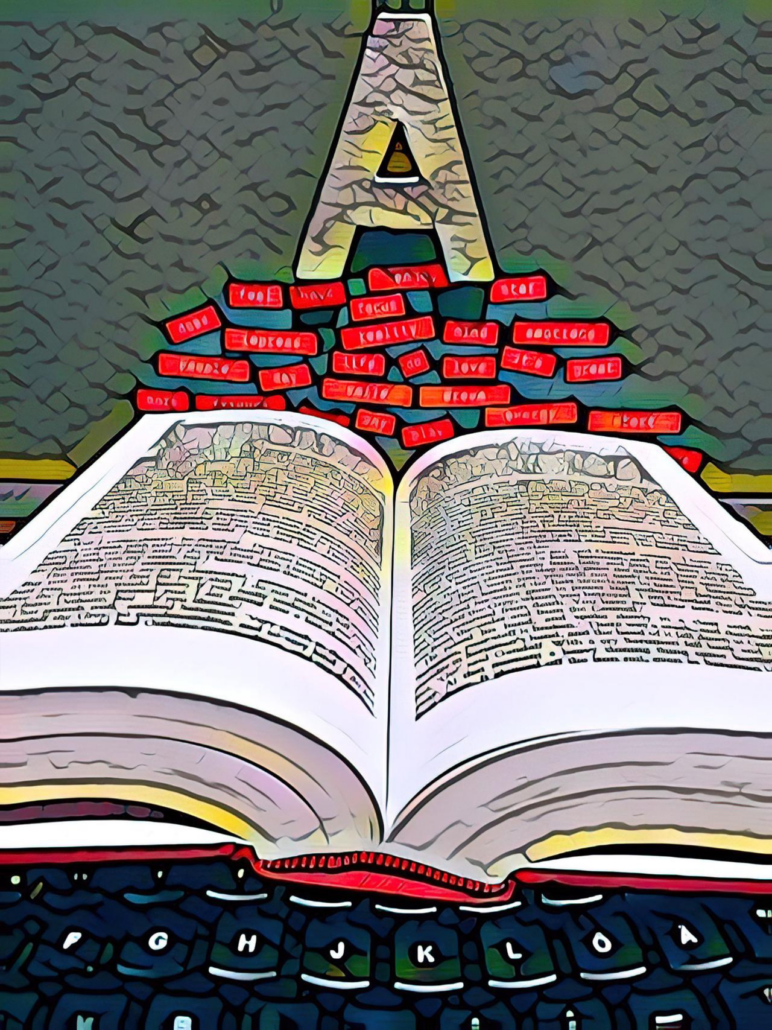
Letter Word Text Taxonomy by Teresa Berndtsson | https://betterimagesofai.org | https://creativecommons.org/licenses/by/4.0/ *
The title of my poem is Please Use AI.
It is an instruction. It is also a lie.
Or perhaps more accurately, it is the kind of lie that tells you the truth by saying its opposite.
I wanted the title to sound cheerful, helpful. Like the language being used to sell us this technology: please, go ahead. Let the machine do it. Save yourself the time. Save yourself the trouble. Why would you struggle when something else can do the work for you?
If you read deeply enough, there is hostility in the poem, although it took me a while to recognize it. I am not usually interested in writing poems that are hostile. Most of my work is concerned with love, grief, beauty, the strange and ordinary ways we remain connected to one another. But I was angry when I wrote this. I still am. I’m angry at the idea that everything difficult in life should be turned into a problem of efficiency. At the thought that pauses should be filled, uncertainties resolved, acts of making reduced to a prompt and a result.
At the suggestion that the struggle was the waste.
That is what the irony of the title is carrying. Please Use AI is not really an invitation. It is closer to a dare. Fine, then. Give it everything. Give it the words you have not yet found. Give it the things you have not yet understood. Give it the work of becoming.
See what is left.
The anger comes partly from watching the internet, the world, fill with things that look finished but have no heart. Images without an artist. Words without a writer. The appearance of expression without the experience that expression is supposed to carry.
I don’t mean that a machine cannot produce something beautiful. It can. I mean that beauty is not the only thing we are making when we make something.
For much of my life, writing has been how I find out what I think. I have written my way towards things I could not otherwise reach. I have started with an idea and found a memory. I have started with a memory and found a wound. I have started with a sentence I thought was true and, several pages later, discovered that it wasn’t. The sentence I was looking for was often hiding behind the sentences I had to get wrong first. That work is not incidental to the writing. It is the writing.
The blank page is not simply the place where a finished thought is deposited. It is where a thought becomes possible. It is the space in which we discover that the thing we thought we wanted to say is not quite the thing we mean.
Sometimes we have to write our way into knowing. Sometimes we have to speak badly before we can speak honestly. Sometimes the first attempt is clumsy and the second is worse and the third finally comes close enough that we recognize ourselves in it.
I think this is one of the things we risk losing when we begin to treat expression as a task whose only purpose is to produce an acceptable result. We are offered a way around the uncertainty. Tell the machine what you mean, or tell it that you don’t know what you mean, and it will give you something polished enough to pass for an answer.
Sometimes that is exactly what someone needs. Assistance is important. Accessibility matters. There are barriers that technology can and should be used to remove. But not every difficulty is a barrier; some difficulties are thresholds. You cross them and find that you are no longer quite the person who stood on the other side.
This is why I am suspicious of the language of optimization when it begins to spread into every corner of our lives. The word sounds so reasonable. Who could be against making things better? Who could be against saving time?
But what if the time is not empty?
What if the hours spent trying to say something are part of the saying? What if the long conversation is changing the people inside it? What if the work of paying attention to someone else is not inefficient, but one of the ways intimacy is made?
We do not become close to people by receiving a summary of them.
We become close by accumulating the small, apparently useless knowledge that no one else would think to collect. The story they always tell in exactly the same way. The thing they pretend not to care about. The expression that crosses their face before they say they are fine. The version of themselves they are only willing to show you after enough time has passed.
Love is made of details that would be absurd to automate.
So is grief.
The work of expression is part of this. We do not only search for words in order to transmit information. We search because someone else is there. The person on the other side of the attempt changes the attempt itself. We try again because we care how the words land. We listen for what we have missed. We discover, sometimes painfully, that what we intended to say is not the same as what another person heard.
The effort to find the right words can make us more attentive to one another. It can make us less certain that we already understand. It can force us to stay in the room with someone else’s experience instead of reaching immediately for an answer.
We do not only search for words in order to transmit information. We search because someone else is there … There is work we do to produce something, and work we do to become someone capable of producing it … I am not interested in romanticizing difficulty. There is work that should be made easier. There is labor that exhausts us without enlarging us … While some work is simply a means to an end, other work is how we become more capable of reaching one another. And some work asks us to sit, for a little longer than is efficient, in the presence of what we do not yet know.
I think this is one of the reasons I write.
Not because I have something to say and need only to find the most efficient way to say it. But I have a feeling that I am trying to capture in language. Sometimes, I do not yet know what I have to say when I sit down to write. And the writing is the process by which I become someone who does.
There is work we do to produce something, and work we do to become someone capable of producing it. The finished poem is not the only thing produced by writing a poem. The person who wrote it has also been changed by the attempt.
That distinction feels important to me because we are increasingly encouraged to judge making by its outcome alone. Is the image good? Is the sentence clear? Is the poem moving? Did the thing achieve its purpose? But there are forms of work whose value cannot be found entirely in the thing they produce.
The attempt to say you are sorry does not only produce an apology. It may require someone becoming more capable of understanding the harm they have caused. The attempt to write a love letter may reveal that the feelings you thought you had are not quite the feelings you actually have. The object is only part of what has been made, but the person making it is the more important part.
And perhaps this is what makes the conversation about AI so complicated. We are very interested in what machines can produce. We are less interested in what the process of producing things has produced in us.
We ask whether a machine can write. I want to ask what happens to the person who no longer does.
Not because every person needs to write a poem. Not because human-made things are inherently better than machine-made things or because struggle is automatically noble. For I am not interested in romanticizing difficulty. There is work that should be made easier. There is labor that exhausts us without enlarging us.
But what I keep coming back to is that while some work is simply a means to an end, other work is how we become more capable of reaching one another. And some work asks us to sit, for a little longer than is efficient, in the presence of what we do not yet know.
The blank page is one of those places. It does not tell you what you mean. It does not make you more articulate than you are. It does not promise that anyone will understand you when you are finished.
It only asks you to begin.
Then to begin again.
Then, perhaps, to discover that the thing you were trying to make was also making you.
<><><><><><><>
* Letter Word Text Taxonomy by Teresa Berndtsson
This image refers to Natural Language Processing, known as NLP, a sub-field of AI enabling computers to understand language. Chatbots, voice assistants, automatic translation, text summarization, speech recognition and synthetic voices are applications that fall under NLP. To be able to communicate we need to have a common language. The symbols, letters and words are the connection between the human and the AI, using these we can communicate with each other. This forms the basis of language models (and wider machine learning), embedded within statistical processes of pattern recognition. Words are placed, as in this image, within a symbolic taxonomy. The letter is a part of a word, which is a part of a sentence, which is a part of a context, which creates meaning. Yet these systems have no real understanding. The illusion of understanding emerges from the pattern they have learned. The single letter ‘A’, missing its counterpart ‘I’ could represent the actual lack of intelligence in these systems. The image was generated by applying a neural network-based technique called ‘style transfer’ using the mobile app Prisma.
A black keyboard at the bottom of the picture has an open book on it, with red words in labels floating on top, with a letter A balanced on top of them. The perspective makes the composition form a kind of triangle from the keyboard to the capital A. The AI filter makes it look messy, with a kind of cartoon style.
https://betterimagesofai.org | https://creativecommons.org/licenses/by/4.0/
https://betterimagesofai.org/images?artist=TeresaBerndtsson&title=LetterWordTextTaxonomy