Department of Psychoanalytic Education (DPE)
© 2009-2026 American Psychoanalytic Association | 122 East 42nd Street, Suite 2310, New York, NY 10168 | Phone: (212) 752-0450 | [email protected]

Welcome to the Department of Psychoanalytic Education (DPE). The DPE promotes excellence and innovation in psychoanalytic education while supporting professional development throughout the analytic life cycle. We approach the tasks of psychoanalytic education, training, and formation of a psychoanalytic identity in a creative, flexible, and disciplined manner. We emphasize critical thinking, depth, breadth, rigor, and exploration of new ideas as psychoanalysis continues to evolve. We believe that psychoanalysis has much to offer and learn from active dialogue with other disciplines. We view psychoanalysis as both a powerful treatment and a powerful method to understand the mind in its depth, complexity, and impact. We recognize that our internal worlds and our social and cultural surround continuously interact and shape each other, and that psychoanalysis has a critical role to play in understanding and addressing pressing issues and dynamics on an individual, group, and societal level. We hope to provide an educational home that fosters ever deepening unique and novel psychoanalytic identities that contribute to these goals.
The APsA Standards and Principles for Psychoanalytic Education guide the DPE in its endeavors particularly with their emphasis on learning and growth throughout the analytic life cycle. We participate in the Inter-Institutional Initiative which meets regularly with institute/center leadership across the country in conjunction with the APsA President, President-Elect and other APsA leadership to discuss common challenges and exchange ideas. As our organizational chart shows, we have eight Sections and two Councils. We also present the DPE Education Forum and the DPE Scholarship Forum at the APsA national meetings. The DPE Head and Associate Head in conjunction with the Chairs of our Sections and Councils, along with our Candidate representatives and Program Committee representative, comprise our Steering Committee. In all its endeavors, the DPE is strictly non-regulatory.
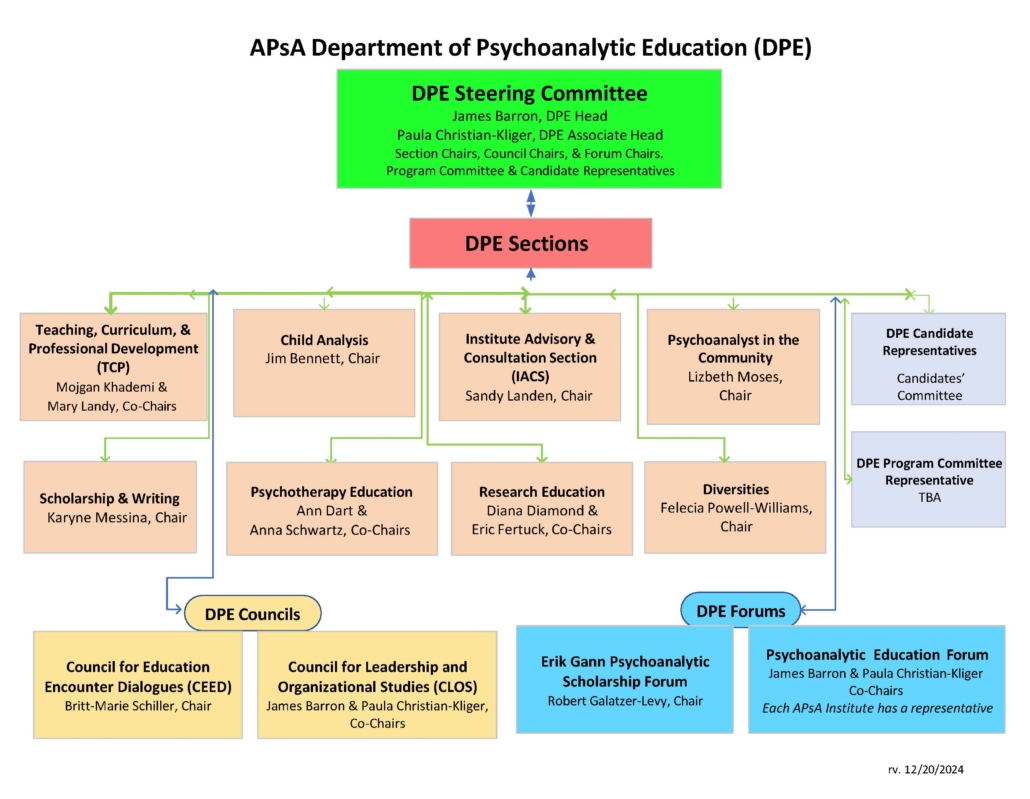
The DPE helps teachers and students engage deeply with psychoanalytic ideas and apply them in our changing world by providing resources to support all aspects of analytic education at APsA affiliated institutes and centers. The DPE Teaching, Curriculum, and Professional Development (TCP) Section provides process and content help with each of the areas in its name, including supervision from a developmental perspective. The DPE Institute Advisory and Consultation Section (IACS) provides confidential help to APsA institutes and centers of a focal, intermediate, or comprehensive nature. The DPE integrates perspectives from each of our specialty-focused Sections, which include Diversities, Research, Child, Community, Psychotherapy, and Scholarship & Writing. The DPE Council of Education Encounters (CEED) provides a forum for collegial exchange of educational ideas and practices in dialogic exchange among teams of colleagues from groupings of APsA and IPA institutes/centers. The DPE Council for Leadership and Organizational Studies (CLOS) provides educational resources to APsA and IPA psychoanalytic institutes/centers and other organizations in our communities to enhance our effectiveness as leaders and promote the health of organizations striving to become more diverse, inclusive, equitable, and just. Click on each for an expanded description of these DPE entities and click on the DPE Library of Resources below. We actively encourage candidate members and participation in DPE endeavors wherever possible. Various DPE components focus on practice development and other pathways to grow professionally, including as leaders confronting challenges vital to the growth and vibrancy of our institutes, centers, and broader field.
Learn More
EDUCATION & TRAINING
For most mental health professionals, the graduate training experience does not fully prepare one to be a skilled, knowledgeable, and confident therapist. While we continue to learn from our patients throughout our professional lives, we believe that advanced formal training is crucial to our efforts to provide the highest level of clinical competence.
More recently, because of the relative neglect of such training in universities and other training programs, psychoanalytic centers and institutes have developed formal instruction programs in the discipline of psychoanalytic psychotherapy.
While individual programs differ in their specifics, typically they are based upon the core psychoanalytic tripartite training model of didactic seminars, clinical supervision, and personal therapy. Programs are available not only in adult psychoanalytic psychotherapy but also in child and/or child and adolescent psychotherapy.
The following programs affiliated with APsA are designed to enrich psychotherapeutic skills and to provide a background in psychodynamic principles and the theoretical basis of clinical work. Click on the links for more specific information on each program:
As interest in the full life cycle from a psychoanalytic perspective is on the rise, our study group has developed the following resources to enable the development of new courses on psychoanalytic perspectives on late-life patients. The links below lead to two model curricula and three extensive bibliography reference resources.
Candidates and members are interested in learning more about this profound period of life and in treating these patients who are often highly motivated and benefit significantly from psychoanalytic treatments. We are offering two overlapping but distinctly different “model” curricula to serve as starting points for training centers and teachers developing such courses. Both curricula focus on the importance of bringing working knowledge of this life phase to our candidates and members.
And, our study group is available to you as an additional resource. Please feel free to be in touch.
Audrey Kavka, Chair
Bob Galatzer-Levy
David Joseph
Patricia Plopa
Daniel Plotkin
Barbara Stimmel
RESEARCH EDUCATION
The Research Education Section of the American Psychoanalytic Association, Department of Psychoanalytic Education (APsA-DPE) in collaboration with the Research Committee of the New Center for Psychoanalysis (NCP).
This collection of Research Education Resources serves to provide materials for stimulating interest in topics and research relevant to psychoanalytic education. Our goal is that materials made available here will stimulate critical thinking and will help ground psychoanalytic training in a framework that integrates psychoanalytic knowledge with relevant findings from other disciplines.
SCHOLARSHIP & WRITING
ORGANIZATIONAL DYNAMICS
DIVERSITIES
PSYCHOANALYSIS IN THE COMMUNITY
MEDIA