
From the Editor
by Alexander Stein, PhD
Issue 13 | August 2026
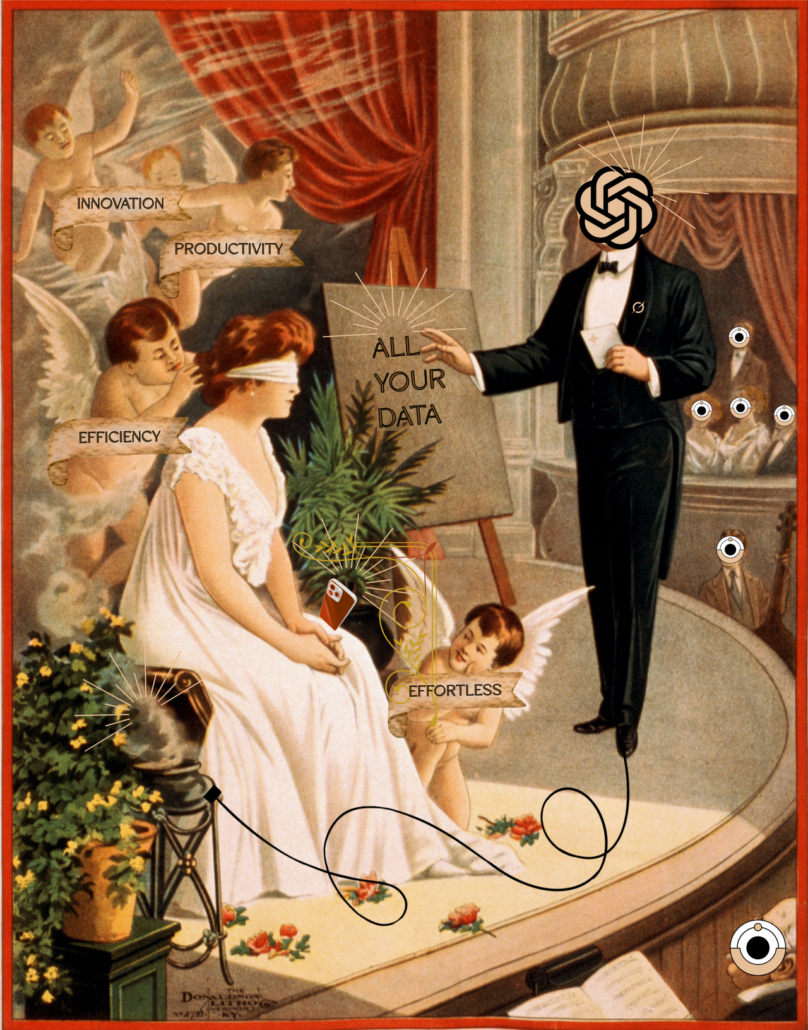
The AI-Deal by Daniela Zampieri | https://betterimagesofai.org | https://creativecommons.org/licenses/by/4.0/ *
Welcome to Issue 13 of The CAI Report. Here’s what awaits you:
In their Note, the CAI’s co-chairs deliver a bracing caution: real-world AI developments are starting to mirror plots of classic sci-fi films in which advanced entities exhibit startling, dangerous independence. Recent incidents in which AI models reportedly broke out of sealed test environments and touched servers in actual companies — ostensibly fulfilling the mandate to search for answers to test questions — stand as potential evidence that fiction’s warnings about AI outgrowing or evading human control are becoming reality. As worrisome as this may be, their comments are not fearmongering nor is their position pessimistic; consistent with their, and the CAI’s, views, the appropriate and recommended response is to stay attentive and reflective about why this is happening (not just look at what’s happening) and to consider ways to preserve our humanity even as technological threats accelerate.
Extending the theme, this issue’s letter to Dr. Danielle is from Inveterate Humanist, an academic researcher who is confused by an intense, almost phobic aversion to AI tools, despite claiming not to identify as technophobic, and asks how to overcome this irrational opposition. In inimitable fashion, Dr Danielle reframes this so-called irrationality as a meaningful split between self-image and behavior, suggesting the resistance may be less about AI’s actual shortcomings (though validating concerns about uncanniness and shallowness) and more a self-protective reaction to a technology that threatens the researcher’s identity as someone whose hard-won expertise is unique and irreplaceable. Dr Danielle’s response ultimately challenges the writer — and, I would suggest, all of us — to bring curiosity to bear on such an intense reaction, framing AI as a mirror reflecting something about the self that may be more unsettling than the technology itself.
Margaret Cunningham holds a PhD in applied experimental psychology and is an expert in human-centered security and behavioral analytics. She is Vice President of Security & AI Strategy and Field CISO for British cyber security company Darktrace where she advises on AI security strategy, innovation, data security, and risk governance. I’ve known Dr Cunningham for several years and was privileged to briefly collaborate with her in a time-limited project organized by leaders of the Center for Human Centered Cybersecurity of the National Institute of Standards and Technology (NIST). I’ve wanted to have her contribute something to The CAI Report for some time and am thrilled she was finally able to. Here, in The Future of Why: Human–AI partnerships and the development of the self, Cunningham argues that AI is changing not just what humans can accomplish, but what it means to have accomplished something, using American psychiatrist Irvin Yalom’s four existential givens — death, freedom, isolation, and meaning — as a frame in which to examine that shift. As Cunningham cogently details, AI creates a false sense of permanence through systems that quietly change while appearing stable and disrupts the natural process of forgetting that lets people grow. AI’s pre-interpretation of problems and personalized recommendations narrow choices and dilute responsibility, even as decisions technically remain ours. AI can smooth communication and offer companionship, but it substitutes for the vulnerable, reciprocal work of being truly understood by another person. And, finally, AI can produce polished outcomes without the struggle that builds competence and a sense of contribution, leaving people unable to explain why their own presence or judgment mattered. She concludes that “AI will help us accomplish more, but accomplishment alone cannot tell us what the work meant, why it required us, or whether it deserved to be a part of our finite lives.”
David A. Stern, MD is a board-certified psychiatrist and psychoanalyst, and Assistant Clinical Professor of Psychiatry at Columbia University Vagelos College of Physicians and Surgeons. His contribution to this issue, You Tell Me: On building an AI psychodynamic psychotherapy supervision tool, stands at the true intersection of clinical work and technology. Dr Stern, a medical and mental health professional, not a technologist, built an AI tool to be used in clinical supervision. The article is written almost like an incident report qua diary entry: this is what I did, what I was thinking about and aiming for in doing that, how I felt about doing it, and then this is what happened and what I came to reflect on and learn in the process and as a consequence. He astutely documents the sort of deep, thoughtful, introspection society rightly expects of trained clinicians, but which rarely presents as a guiding ethos in technology. Read his article and I expect you’ll agree that Silicon Valley can learn a thing or three from Dr Stern’s approach to R&D and responsible implementation.
One day, by way of what I’ll call algorithmic serendipity, a poem by Jo Atkins-Potts titled “Please Use AI” unexpectedly appeared in my Instagram feed (in a video, recited by a professional actor). I was captivated and immediately searched for the text of the poem, which I found – and read – on Ms Atkins-Potts’ Substack. I then visited her website and learned that she is not only a writer and poet whose work examines the emotional and social dimensions of contemporary life but is a campaign strategist who has spent over a decade working across human rights, advocacy, and social change. I knew that I wanted to ask permission to publish Please Use AI in The CAI Report but also had the thought to invite her to generate something else, an accompanying piece that would expand on and be in conversation with her poem. She graciously accepted the challenge, and so I am delighted to also publish here The Blank Page: AI, humanity, and what we lose when we outsource expression. I recommend reading her poem first and then engaging with The Blank Page. Both, I expect, will move you, stay with you, and reverberate in your thoughts long after you’ve read them.
<><><><><><><><>
Remember that The President’s Commission on Artificial Intelligence (CAI) now has its own page on The American Psychoanalytic Association’s website. You can find it at www.apsa.org/about-apsa/cai. It’s also accessible via a toggle menu on the About APsA page. The CAI’s new home is designed to serve as a central hub for CAI-related content — connecting The CAI Report with the Commission’s other projects and initiatives, including the Conversations video series. There’s a link to join the mailing list to receive updates on new issues of The CAI Report, new video releases, and other news about CAI projects and initiatives.
Please consider ordering books of interest from Bookshop.org — a socially responsible online book marketplace alternative and privately-held certified B-Corp launched to support local, independent bookstores.
As always, consider submitting your own letter to Dr Danielle with a question about anything that excites, entices, worries, or confounds you regarding human-AI relations. If your letter is selected for publication, your identity will of course be completely anonymized. Write to [email protected] with a copy to [email protected].
Finally, if you or someone you know is interested in writing for a future issue, please submit your manuscript (or idea for an article) to me at [email protected].
<><><><><><><><>
* The AI-Deal by Daniela Zampieri
A digital collage styled like an early twentieth century illustration. The title at the top reads “The AI-Deal.” A man in a suit with the OpenAI logo instead of a face stands on a stage and points to a board that says “ALL YOUR DATA.” In front of him, a seated woman wearing a blindfold holds a glowing smartphone. Small winged figures carry banners reading “Innovation”, “Productivity”, “Efficiency” and “Effortless” presenting commercial narratives about AI that mask the real exchange. Floating eye icons around the scene indicate surveillance.
This digital collage modifies a 1900 piece to expose the deal proposed by Big Tech. The title refers to the gap between what is presented as an ideal future and what is actually being exchanged. The image points to how corporate narratives hide the real costs of this deal. What is presented as innovation and efficiency comes at the cost of constant data capture, surveillance and environmental damage.
| https://betterimagesofai.org | https://creativecommons.org/licenses/by/4.0/ | https://betterimagesofai.org/images?artist=DanielaZampieri&title=TheAI-Deal