
From the Editor
by Alexander Stein, PhD
Issue 11 | April 2026
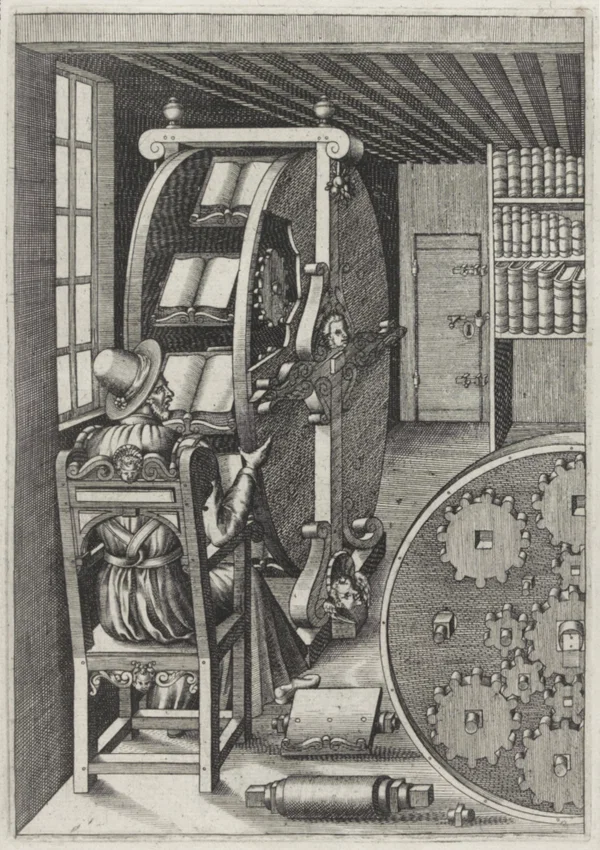
Agostino Ramelli’s Bookwheel (in Le diverse et artificiose machine, 1588)
For some issues of The Report, I set out to curate articles around a particular idea or theme. For this issue, the interconnectedness between and among the pieces only emerged as I began editing them and compiling the issue for publication.
The contributions on offer here share several themes:
All three argue that AI lacks something irreducible to human experience — an unconscious, genuine subjectivity and emotional capacity, and reciprocity/embodiment/intersubjectivity. None frames this as a technical limitation to eventually be solved; each of the authors treats it as a categorical difference between machines and humans.
Each article emphasizes the danger of simulation without substance: the risk of AI appearing to do something it cannot actually do — appear to listen and interpret, to connect and care, to recognize and understand. The harms identified aren’t that AI fails per se, but that it succeeds superficially while hollowing out the real thing underneath.
The papers converge on a common concern: that sustained engagement with AI degrades something in us. For all the contributors, the threat is not dramatic — it’s quiet, cumulative attrition.
Given these shared perspectives, it should be no surprise that all three are grounded in a broadly psychoanalytic view that meaning, growth, and selfhood emerge between subjects — not within an individual and certainly not between a person and a machine. AI’s incapacity for genuine intersubjectivity is therefore not just a design gap but a philosophical disqualification.
Finally, while each article has a psychoanalytic framing, none limits focus or concern to clinical work. All the authors are making a broader argument that offloading relational and psychic labor to machines threatens something foundational about what it means to be human — how we think, feel, grieve, grow, and relate to one another.
I hope you enjoy and learn from these important works.
The letter to Dear Dr. Danielle describes a challenging workplace issue. The writer’s complaint is not uncommon; a letter like this wouldn’t be out of place in The Financial Times, the Wall St Journal, or other business publication. But the letter-writer’s lead-in concern – the pain of working in an office defined by fear and toxicity because of a nasty manager whose insecurity-driven mood swings and belligerence are crushing morale and productivity — gives way to wondering if things might improve by replacing this terrible boss with an AI agent. The question is provocative (it also flips the usual talking point about workers being replaced) and Dr. Danielle responds to the writer’s workplace predicament with empathy and pragmatism. She also brings psychoanalytic wisdom to both the underlying significance of the fantasy of an AI supervisor and a forecast of what it might actually be like if the wish could be fulfilled.
As always, consider submitting your own letter to Dr Danielle with a question about anything that excites, entices, worries, or confounds you regarding human-AI relations. If your letter is selected for publication, your identity will of course be completely anonymized. Write to [email protected] with a copy to [email protected].
S Berlin Brahnam is a psychoanalyst, computer scientist, and professor of computer information systems whose research interests include decision support systems, artificial intelligence and computer vision, modeling and simulation, cultural and ethical aspects of technology, and rhetoric and conversational agents. All combine and are brought to bear in Questioning Artificial Intelligence in Psychoanalysis where Brahnam asks whether AI systems, as “talking things” lacking an unconscious, can ever truly replicate the role of a psychoanalyst, who operates as a “speaking being” fundamentally structured by language and lived experience. The article traces the cultural history of nonhuman speech — from mythological tricksters to enchanted household objects — to frame how AI chatbots represent an unprecedented collapse of the boundary between fantasy and reality. The core ethical question is whether automating the analytic position — conferring the analyst’s role onto a talking thing — would risk fundamentally distorting what psychoanalysis is, what it requires of practitioners and offers to patients, and degrade the deep human knowing that make psychoanalysis uniquely meaningful.
In Issue 8 (November 2025), The CAI Report published The Great Illusionist and the Digital Double: Psychoanalytic Reflections on Artificial Intelligence in the Advent of a Hyperbolic Reality, a revised and specially adapted English-language version of a 2025 article by Filipe Leão Miranda and Joana Pizarro originally published in Revista Portuguesa De Psicanálise. I’m delighted to present Pizarro and Miranda’s most recent work, From Mnemosyne to the Synthetic Dead Mother? Exploring the Emotional Effects of Chatbot Use, their latest entry in an ongoing series of psychoanalytic reflections on the impact of AI on human development and the mind. Here, they argue that AI chatbots, while powerful tools, pose serious psychological risks by mimicking genuine human connection without possessing any real subjectivity or emotional capacity. They suggest that prolonged reliance on chatbots — especially by children — can erode critical thinking, impair emotional development, and foster unhealthy dependency. Building on André Green’s and Jed Sekoff’s formulations of the “dead mother complex” they introduce the concept of a “Synthetic Dead Mother” to describe how chatbots may act as deadening objects that suppress authentic emotional growth and the capacity for real human relationships. Pizarro and Miranda conclude with an urgent call for regulatory frameworks and design guardrails to protect vulnerable users from these harms.
Mette Charis Buchman, an organizational psychologist and consultant, argues in The Machine That Does Not Dream: A Psychoanalytic Reflection that the rise of AI poses a deeper challenge than job displacement or technological risk — it threatens the relational and psychic conditions through which humans make meaning. She contends that AI offers recognition, reassurance, and coherence without the reciprocity, embodiment, and intersubjectivity that genuine human relationships require, creating the risk that people will increasingly outsource psychic and relational labor to machines, eroding the transitional space needed for reflection, dreaming, and authentic thought. The task, Buchman suggests, is not to humanize machines, but to preserve the embodied, relational conditions under which we can continue to think and feel together.
Thank you for reading.
================================
Remember that there’s a link on The CAI Report landing page where you can enter your email address to sign up to get updates about new issues of The CAI Report, future CAI events, workshops, videos, resources about artificial intelligence and psychoanalysis, and more.
As always, please consider ordering books of interest from Bookshop.org — a socially responsible online book marketplace alternative and privately-held certified B-Corp launched to support local, independent bookstores.
Finally, if you or someone you know is interested in writing for a future issue, please submit your manuscript (or idea for an article) to me at [email protected].