
From the Editor
by Alexander Stein, PhD
Issue 14 | October 2026
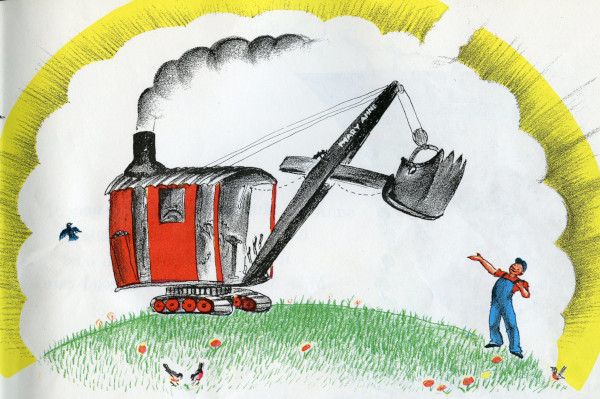
Mike Mulligan and His Steam Shovel by Virginia Lee Burton, 1939 © Houghton Mifflin Company
Mike Mulligan and His Steam Shovel is a classic 1939 children’s book by Virginia Lee Burton. In the story, Mike Mulligan and his old-fashioned steam-powered shovel, named Mary Anne, valiantly try to compete with faster, more powerful modern excavators but are ultimately overtaken and rendered obsolete. The story captures an enduring anxiety; a 1997 Time Magazine article described the dawn of the computer-in-every home/internet era as ‘The Mike Mulligan Moment.’ The parable is no less apt today as people navigate disruption in the age of artificial intelligence, hoping to fare better than Mike and Mary Anne (the story ends with Mike unable to get Mary Anne out after digging a cellar so she is converted into the new building’s boiler, and he becomes its janitor).
As we approach the end of 2026, artificial intelligence and the array of technologies under that umbrella term are being marketed and increasingly implemented not just as new-fangled tools catalyzing displacement and adaptive workforce reuse but as entities intended to serve as proxies for people across a spectrum of functions and capabilities, including in domains long-considered irreplaceable by non-humans. The articles in this issue, as well as the letter to Dr. Danielle and Note from the CAI’s co-chairs, take-up these issues, extending the deep psychoanalytically informed exploration of AI’s impact and influence on people and society that’s at the heart of The CAI Report’s mission. I hope you find everything presented here stimulating and thought-provoking.
This issue’s letter to Dr. Danielle is from Babette, who writes about how much she despises the AI-powered delivery robots that dart around the streets of Philadelphia carrying food orders to homes and offices. You won’t want to miss Dr Danielle’s incisive analysis of the psychological challenge encapsulated in these pint-sized delivery bots and Babette’s response to them (hint: technology is not only changing what machines can do but also changing the emotional relationship we are being pressed to have with them).
The Algorithmic Oracle: AI, Tarot, and the Wish for Certainty is a startlingly original article by M Grover, a UK-based organizational researcher and consultant working in systems psychodynamics whose research examines authority, group relations, institutional mourning, and how organizations negotiate dependency, difference and uncertainty. In this piece, Grover juxtaposes traditional tarot reading, AI tarot, and psychoanalysis. Tarot, she explains, is slow, shared, and tolerant of ambiguity, and bears some similarity to analysis where many patients turn with “the hope that somewhere there exists a position from which uncertainty no longer looks uncertain.” In both, authority is invested outside the self manifestly in pursuit of clarity but also, unconsciously, as a repetition in which analyst or tarot (and the reader) can “come to occupy an older relation to authority or care, so that an interpretation carries more than the words themselves.” In AI Tarot, a spread uploaded to a tarot bot can be instantly turned into a coherent interpretation, returning an answer that sounds more settled than the question itself has yet had time to become. Taking AI tarot as a meta-metaphor for the insistent AI-ification of society, Grover deftly probes at the risks in tarot bots’ acceleration of processes that ought to remain slow, asking “what happens when the slow and often shared work of turning confusion into a story gets done in a sentence?” Her article is important – explicating complex issues around how “the wish to stay close to mystery sits beside another wish, to have mystery made answerable” and its implications to our relationships with ourselves, each other, and our technologies.
Zeynab Javid is a psychoanalytically oriented psychotherapist in private practice in Iran. Trained first in medicine, she later earned a master’s degree in psychology and is currently pursuing a PsyD in clinical psychoanalysis at the University of Tehran. In Programming Affect in Artificial Intelligence: The Possibility of Coding an Affective Organization, which is based on her forthcoming book, she asks whether affect – our emotional states — can be mapped precisely enough to be formalized and coded – a psychoanalytic framework she calls ‘Affective Structure’ — and, if so, what that would mean for artificial intelligence and, conversely, how it could facilitate psychoanalysis contributing to the design of AI. Javid proposes considering affect as organized in a relational system loosely analogous to the analyst-patient relationship which she systemizes as Core 1 and Core 2. In this model, one core receives, processes, and returns the second core’s raw feelings in digestible form. Recognizing that the analogy has its limits – AI systems are not the same as human relationships – she raises a concern: an always-available, tireless AI would, contravening Winnicott, be a more-than-good-enough mother, removing the small, tolerable frustrations through which we build a capacity to bear difficult feelings. Importantly, she makes no definitive claim that affect is codable, only that the question is worth asking and in posing it, could prompt psychoanalysis to formalize its observations to open a new dialogue with mathematics, computation, and the study of artificial systems.
Machine agents are increasingly designed to operate autonomously in society in ways indistinguishable to humans or to erase any sense of interacting with a non-human entity (see also Anthropic’s recent gobsmacking ban on ‘sustained and needless abusive or cruel behavior” toward its models). One consequence of positioning computational systems in these radically anthropomorphized ways is that as their capabilities amplify, so does the scope for potential misuse. Scarcely a day passes without a report of artificial intelligence being used in scams, hacking, and other criminal activity. Against this backdrop, I’m including From the Imitation Game to Techno-Imposters: How AI Became the Ultimate Tool for Psychological Manipulation and Fraud. I argue in this article that AI is no longer merely a cutting-edge instrument in the knowing commission of nefarious activities; so-called agentic AI can now itself function as an imposter – the assumption of a false or disguised identity to deliberately deceive. In this new environment, the fraudster is not a person but a computational system. “Techno-imposturousness,” as I’ve named it, isn’t equivalent to a Trojan horse, boiler room, Nigerian prince, charlatan’s grift, or other conventional deceptive practice. Even so, we are being bamboozled and groomed to enable what may come to be understood as the most far-reaching and consequential fraud in history – willingly abdicating human agency to computational fakery.
[Note: I define the parameters of my role as Editor of The Report to inviting, curating, and helping to refine the ideas, perspectives, and voices of the writers and thinkers whose work I select to publish. This marks the first time I’ve included my own work (excluding my Editor’s Introductions prefacing each issue) and anticipate this will be a rare exception to my general guideline].
The issue concludes with The Pro-Human AI Declaration, which was first issued in March 2026 by a coalition of interest groups and individuals organized by the Future of Life Institute (a US-based non-profit focused on steering transformative technology towards benefitting life and away from extreme large-scale risks). It’s organized into five themes: (1) Keeping Humans in Charge; (2) Avoiding Concentration of Power; (3) Protecting the Human Experience; (4) Human Agency and Liberty; and (5) Responsibility and Accountability for AI Companies. Under those categories, the Declaration lays out 33 principles to help ensure AI serves humanity, not the other way around. A remarkably broad coalition is behind the new Pro-Human AI Declaration, with both organizational and individual endorsers. The CAI Report proudly joins them; publication here stands as a formal endorsement of the Declaration’s principles,
<><><><><><><><>
The President’s Commission on Artificial Intelligence (CAI) has its own page on The American Psychoanalytic Association’s website. You can find it at www.apsa.org/about-apsa/cai. It’s also accessible via a toggle menu on the About APsA page. The CAI’s new home is designed to serve as a central hub for CAI-related content — connecting The CAI Report with the Commission’s other projects and initiatives, including the Conversations video series. There’s a link to join the mailing list to receive updates on new issues of The CAI Report, new video releases, and other news about CAI projects and initiatives.
Please consider ordering books of interest from Bookshop.org — a socially responsible online book marketplace alternative and privately-held certified B-Corp launched to support local, independent bookstores.
As always, consider submitting your own letter to Dr Danielle with a question about anything that excites, entices, worries, or confounds you regarding human-AI relations. If your letter is selected for publication, your identity will of course be completely anonymized. Write to [email protected] with a copy to [email protected].
Finally, if you or someone you know is interested in writing for a future issue, please submit your manuscript (or idea for an article) to me at [email protected].