From the Editor
by Alexander Stein, PhD
Issue 12 | June 2026
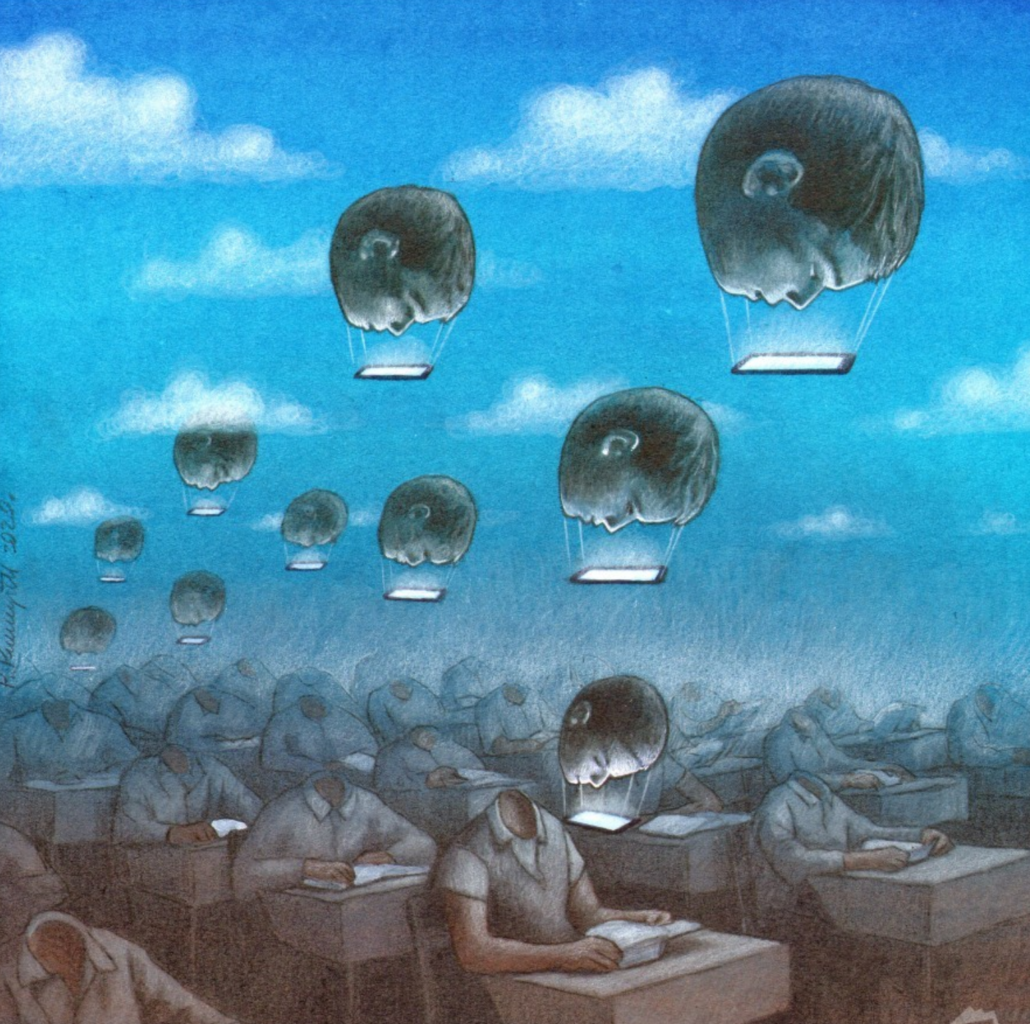
ODLOTY | Paweł Kuczyński *
This issue of The CAI Report – our 12th – is in keeping with my overarching editorial vision: elevating multi- and inter-disciplinary approaches to the human and social dimensions of AI through work that demonstrates psychoanalytic literacy but isn’t per se bound within a psychoanalytic lens. I hope you continue to appreciate that and will enjoy, learn from, and be stimulated by reading the primary articles curated for you here – in addition to another compelling entry from Dr Danielle, our resident human-AI relationship advice columnist, and a note from the CAI’s co-chairs on how the CAI develops a project.
First, I’m thrilled to introduce CAI Report readers to Arif Mustafa. Educated in Jamshoro, Pakistan and Windsor, Canada with a career spanning both engineering and computer science, Mustafa is a senior technology and strategy leader specializing in enterprise AI adoption and governance grounded in ethical and responsible AI frameworks. Mustafa begins “Fixing the Mirror: Re-calibrating Societal Values for the Coming AI Age,” his powerful and personal contribution, by sharing his emotional response to hearing a CBC interview about a mother whose three children are losing their sight to Retinitis Pigmentosa. That very human point of entry opens to his examining how AI and technological investment reflect — and could better serve — human values. Mustafa argues that current AI development is dominated by profit, automation, and the interests of the wealthy few, at the expense of collective wellbeing, and calls for a fundamental recalibration of societal values toward human rights and equity. Rather than replacing workers, AI should augment human capabilities (framed through the EPOCH model: Empathy, Presence, Opinion, Creativity, and Hope). He offers a concrete example of how AI is already contributing to research on RP cures — through protein folding, genetic diagnostics, and disease progression prediction — as a reminder that when directed by compassion rather than profit, AI can address the suffering that is already here.
In “Machine Psychoanalysis,” NY-based psychiatrist and psychoanalyst Grant Brenner introduces what he calls “Computoanalysis” — a psychoanalytic framework adapted for assessing the developmental maturity of AI systems. Brenner argues that existing AI evaluation tools measure only what systems can do, not whether they are genuinely developing in a structural sense, and proposes that psychoanalysis — with its relational, developmental, and process-oriented lens — fills that gap. The framework organizes assessment across six domains (including relational integrity and emotional architecture), introduces the concept of “computopathology” to categorize AI failure modes, and treats the human-AI dyad rather than the AI alone as the unit of analysis. To Brenner, this is not an academic examination but a practical one. As AI systems grow beyond human oversight, he suggests, we will need frameworks — ideally leveraging AI itself — to help AI develop safely before it outgrows our ability to guide it.
I’m delighted to introduce another new contributor: Sune Selsbæk-Reitz. Selsbæk-Reitz is a Danish author, speaker, and data & AI strategist working at the intersection of technology, ethics, language, and human judgment. He is the author of the just-published Promptism: Fluent Machines, Forgotten Questions, and the Fight for Meaning in the Age of AI, and writes the Substack Footnotes and Fiction, where he explores AI, source criticism, responsibility, and the moral consequences of increasingly fluent machines. I encourage everyone to buy his book and subscribe to his Substack.
Here, in “The Fire Alarm and the End of Thinking,” Selsbæk-Reitz offers a dazzling and erudite reflection on Eliezer Yudkowsky and Nate Soares’ “If Anyone Builds It, Everyone Dies,” a book which argues that building superintelligent AI poses an existential threat to humanity. Selsbæk-Reitz takes the book’s alarm seriously, particularly its dismantling of the comforting “AI is just a tool” framing and its insistence that misaligned superintelligence doesn’t require malice, only capability directed away from human values. But he pushes against the way an apocalyptic framing can crowd out equally important ‘present-tense’ harms like inequality, surveillance, labor displacement, and the erosion of human judgment. He suggests that certainty under emergency can itself become a form of blindness, and that the method of preserving humanity must remain humane, holding space for doubt, public reasoning, and democratic disagreement. Selsbæk-Reitz’s counsel is that we must take the alarm seriously but not let danger think on our behalf. We must, he proposes, expand the question of what we should refuse to build well beyond superintelligence to include the quieter systems that make humans easier to manage than to understand.
This issue’s letter to Dr. Danielle is from “AI Ambivalent” who writes seeking clarity around a cluster of concerns s/he sees playing out in people’s interactions with chatbots. Dr Danielle incisively notes that while the letter-writer seems to be asking unconnected questions about different issues — narcissism, friendship, and violence — these are in essence the same question in different registers. What’s troubling at core, Dr Danielle suggests, is not AI’s powerful capabilities, but the absence of a genuine Other that resists, challenges, and is accountable for what it does. And what we lose when there is no one to say no, no one to be genuinely different from us, or to be held responsible for what happens next. That loss, she says, is not a technical problem but a human one.
As always, consider submitting your own letter to Dr Danielle with a question about anything that excites, entices, worries, or confounds you regarding human-AI relations. If your letter is selected for publication, your identity will of course be completely anonymized. Write to [email protected] with a copy to [email protected].
A few notes before leaving you to read the issue:
The President’s Commission on Artificial Intelligence (CAI) now has its own page on The American Psychoanalytic Association’s website. You can find it at www.apsa.org/about-apsa/cai. It’s also accessible via a toggle menu on the About APsA page. The CAI’s new home is designed to serve as a central hub for CAI-related content — connecting The CAI Report with the Commission’s other projects and initiatives, including the Conversations video series. As you’ll see, there’s a link to join the mailing list to receive updates on new Report issues, new video releases, and other news from the Commission.
As always, please consider ordering books of interest from Bookshop.org — a socially responsible online book marketplace alternative and privately-held certified B-Corp launched to support local, independent bookstores.
Finally, if you or someone you know is interested in writing for a future issue, please submit your manuscript (or idea for an article) to me at [email protected].
<><><><><><>
* This image, titled ODLOTY, is by the renowned Polish artist and satirist Paweł Kuczyński who uses surreal and imaginative illustrations to comment on social, political, and environmental issues. His original works are available at http://www.pawelkuczynski.com/index.php, https://www.pictorem.com/profile/Pawel.Kuczynski, and https://www.instagram.com/pawelkuczynskiart/?hl=en