
The Algorithmic Oracle: AI, Tarot, and the Wish for Certainty
by M Grover
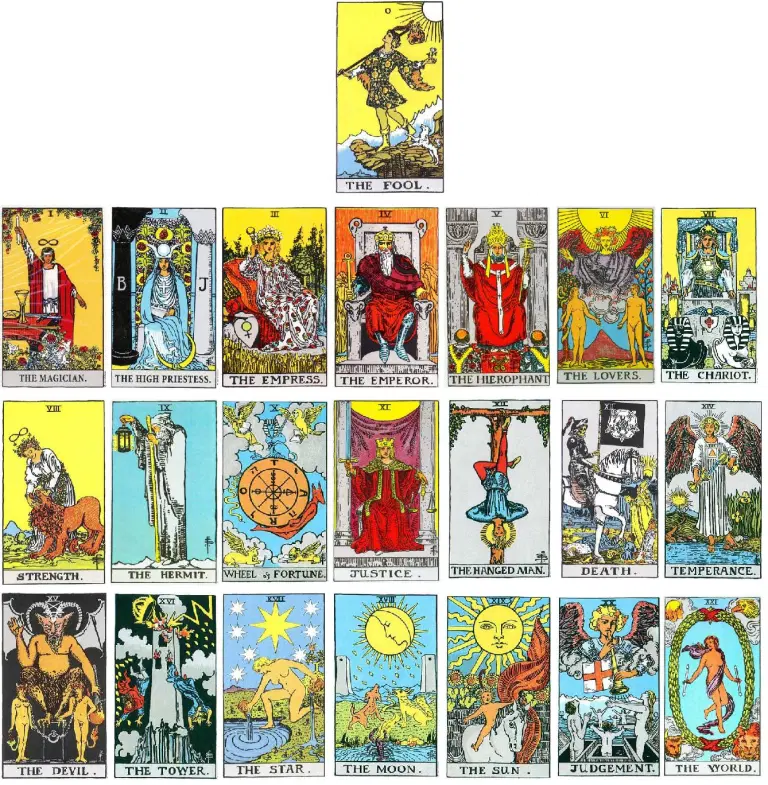
The Major Arcana in the Rider–Waite Tarot deck
A tarot reading offers a table, a spread of images and someone to consult, but above all, time for the cards to acquire meaning. Often, it can last for most of an hour, giving the person enough space for the question itself to keep changing, sometimes until the more vulnerable question underneath it comes to the surface. The reader’s silence can do as much work as whatever is eventually said, and the waiting becomes part of the reading. The same cards can be photographed and uploaded to a chatbot, which begins answering almost immediately. Before the person who drew the card has spent very long looking at it, its uncertainty has already begun to take the shape of language.
AI tarot has arrived alongside the other things people now bring to chatbots, including questions that might once have gone to a friend or simply remained unanswered for a while. Astrology apps produce a personalized transit on demand; tarot bots draw a card and interpret it in the same breath. A person can consult a machine instead of a reader, or instead of their own uncertainty, and the machine will keep answering for as long as the exchange continues. Part of what separates card and chatbot is tempo. Tarot, at its best, is slow on purpose, and can keep more than one meaning alive in a single image without insisting that one of them win immediately. Generative AI more often runs in the opposite direction, gathering whatever it is handed into language that sounds coherent and personal, however tangled the material underneath.
Once meaning can be produced on demand, accuracy is no longer the only interesting question. What interests me more is what happens when the slow and often shared work of turning confusion into a story gets done in a sentence. AI tarot puts that shift on a table small enough to watch. The wish to stay close to mystery sits beside another wish, to have mystery made answerable. A chatbot can serve either one, opening the image further or allowing the symbol to license an answer before the person has had much time to wonder what else the card might have meant.
The scene itself has a history. Tarot did not begin as divination. The earliest decks appeares in fifteenth-century northern Italy as playing cards, while their more systematic occult and divinatory associations developed much later, particularly from the eighteenth century onward (Decker, Depaulis, & Dummett, 1996). By the time Pamela Colman Smith[1] illustrated the Rider-Waite-Smith deck in 1909, the cards had already passed through several lives. Smith’s fully illustrated Minor Arcana which gave the numbered minor cards full scenes rather than rows of cups, swords or pentacles (the ‘suits’ of tarot cards), changed something again, because there was suddenly much more in the image itself to read. That history also complicates the idea that tarot comes with a settled language of meaning. The cards have repeatedly been asked to hold things they did not begin with. They are not blank, but neither do they finish the thought for the person looking at them. A question is placed beside an image, and whatever follows has to be made somewhere between the two.
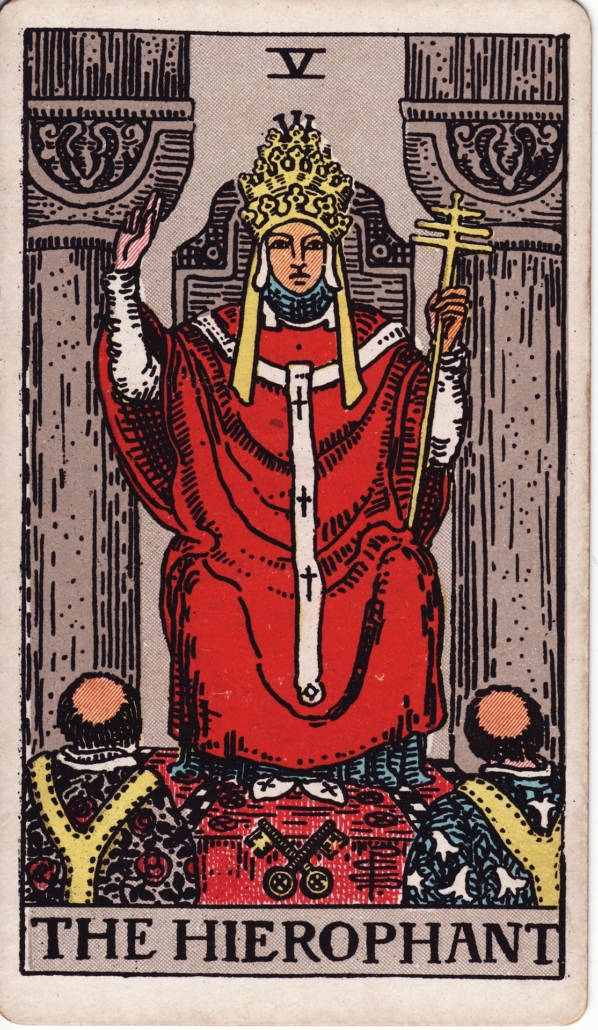
The Hierophant card from the Rider–Waite Tarot deck, 1910
Take the Hierophant from the Rider-Waite-Smith deck. Pamela Colman Smith places him between two pillars in the robes of office, one hand raised in blessing, two figures kneeling with their backs to us. He belongs to the twenty-two major arcana, cards that tend to carry the larger structural matters of a reading, particularly those concerned with authority and the forces a life feels acted upon by. The authority in the picture can bless or withhold. It can offer entry into a tradition or name the price of belonging to one. For a reader, the Hierophant is perhaps the card nearest to a superego, the internal voice of how things are done. Guidebooks give him as spiritual authority and tradition, but that is a definition rather than a reading. A reading begins when the card turns awkward against a particular question. Next to The Lovers, it might mean marriage or family sanction, desire made to prove itself respectable before it may proceed. Next to The Tower, it can become the institution just before the scandal, or the law just before its violence is felt by the person standing inside it. In a question about work, the Hierophant might expose the wish to be recognised by the very system one resents; in a question about faith, it might ask whether a tradition is still believed or merely repeated.
That the card does not settle easily into one meaning seems less a defect than part of the method. One person sees the crossed keys at the Hierophant’s feet as an invitation into knowledge; another sees knowledge locked away, the keys turned so that neither will move. What the querent brings changes which reading becomes possible. The image is finished, in part, by the person looking at it, and this may be the first thing a reading shares with an analysis. A great deal can depend on the pause before a card settles into a single meaning. It has been drawn, but its meaning has not yet arrived. The first reading is usually too easy, borrowed from the guidebook. A second may be too flattering, shaped by the reader’s wish to be liked. A third can disturb the question itself, so that the querent finds the real question was never whether the relationship would last, but whether they were allowed to want it to end. Part of the appeal of the card may be that the question can be put somewhere outside the person asking it without ever becoming entirely external.
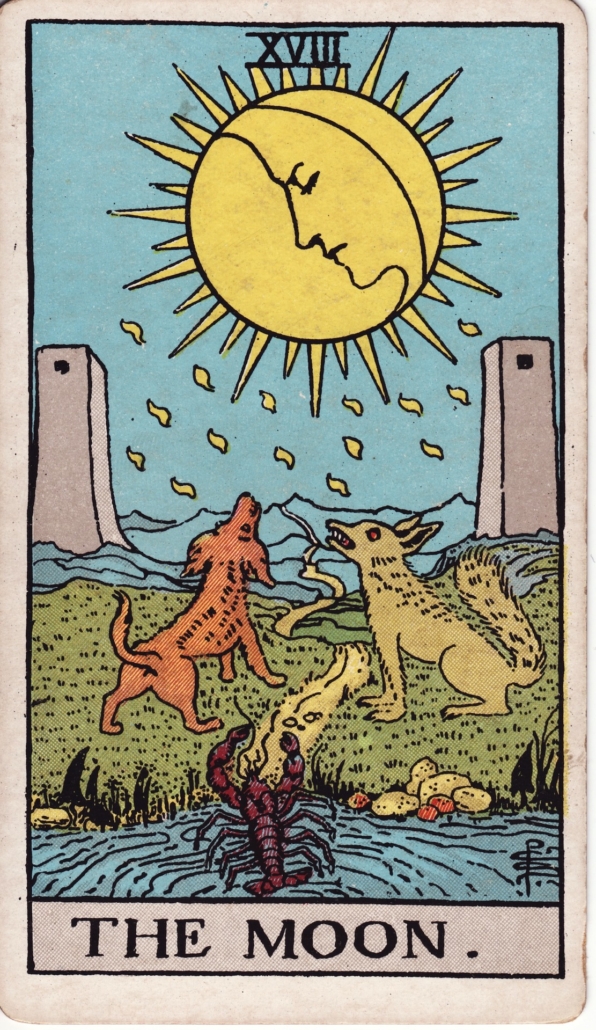
The Moon tarot card from the Rider–Waite Tarot deck 1910
If the Hierophant carries one kind of uncertainty, the Moon carries another. Two towers frame a path rising into the dark, while at the waterline a crayfish drags itself onto land, something from underneath appearing before it has quite taken shape. I think of the Moon as an emotional landscape of the tarot, but the interpretation offers a fear of perception, and what feels like intuition may be entangled with something older and less trustworthy. In a new relationship the card might ask whether dread is reporting something real or repeating something old. In creative work, the crayfish might be the idea that has left the water and not yet grown legs. The cards offer very different pictures, but both resist being paraphrased in one direction. Across seventy-eight cards, that resistance is arguably much of the technique.
If I return to the pause, I inevitably return to the question between the two people in the room. They may find themselves tussling with what it means, while the symbols on the table begin to share in the authorship of whatever is eventually said. “The Hierophant is asking about permission” can be heard differently from “I think you want someone to give you permission.” The card takes some of the pressure out of saying and being said to because both people can look somewhere else. This is where the resemblance to clinical work begins for me. Tarot reading is not analysis, but both can make use of an indirect route towards something that cannot yet be approached head-on. The card also complicates who is supposed to know. It seems to know because it has been drawn; the reader seems to know because they can interpret it. The querent knows more of the story than either of them but has come because what they know has not been enough. “Does he love me?” can therefore contain another question about where knowledge of that love might exist at all, and who can be trusted to possess it.
Transference makes the analytic version of this less straightforward. An analyst can come to occupy an older relation to authority or care, so that an interpretation carries more than the words themselves. Tarot distributes authority differently. The card can lend authority to the reader while making that authority appear to come from somewhere beyond the reader: not simply I am telling you this, but this is what has appeared between us. Something related can happen through the analytic frame, where an interpretation is spoken by one person but acquires some of its authority from the setting in which it is spoken. “Between us” is not an innocent place. Authority can be put there too.
A reading I once sat in on brought some of this into focus. The man had arrived with a question large enough to hold several parts of his life at once, particularly his work and his marriage, along with things that had not quite been named. As the reading went on, another question began to appear underneath the first. It became less about what was coming and more about what he might already be letting go, and whether the letting-go itself could be trusted. The reading did not settle this. Things could work out; they could also not. What changed was what seemed to be at stake in asking, and that change needed time. An interpretation does something when it arrives as well as meaning something. An unexpected silence or a return to a card that had seemed unimportant can pull a reading somewhere else without proving that the interpretation was right. The reader then must decide whether to stay with the response, revise what has been said, or simply let the silence remain for a while.
Psychoanalysis has long lived with this problem. An interpretation can be accurate and still arrive at the wrong moment. It can name something before the person has enough distance from it to think, so that what sounds like understanding closes the space in which understanding might have developed. The moment after the interpretation belongs to it too; what has been said is not yet the same thing as what it will become. There is an omnipotent edge to the wish that brings a question to an oracle as well, though I do not mean only the fantasy of controlling what will happen. There is also the hope that somewhere there exists a position from which uncertainty no longer looks uncertain. An analyst can be placed there, imagined to know what the patient cannot know about themselves. Analysis cannot leave that fantasy intact forever. The analyst misunderstands, does not answer, goes away, ends the hour. However frustratingly, another person remains there who cannot be made entirely available to the wish placed upon them.
The pressure does not stay only with the person asking. In Bion’s development of projective identification, something that cannot yet be held within the self may be put into another person and begin to be experienced there (Bion, 1962). Container and contained name what can happen when another mind receives what has not yet become thinkable without immediately giving it straight back. The language can make this sound tidier than it is. Another person may find themselves pulled towards reassurance or towards certainty without immediately knowing why. That does not decode the querent, but it does mean that what entered the relationship encountered another mind and had consequences there. The card cannot have that experience. It can take the question symbolically, but it cannot feel the pressure placed upon it. The reader can. If the Hierophant has to become permission, the reader may begin to feel the pull to grant it. By the time an interpretation comes back, the question has passed through an image and through someone who could not remain entirely untouched by receiving it.
Winnicott’s account of using an object takes the problem somewhere else. The object survives its destruction in fantasy and, through surviving, begins to be discovered as something outside omnipotent control (Winnicott, 1971). Tarot contains a modest version of this resistance. The image can be read in several directions, but it does not disappear into whatever the querent wants most badly for it to say. The Moon keeps the details Smith gave it, even when the querent would prefer the picture to resolve in another direction. The reader, too, can hesitate or simply see something else. The question has therefore done more than leave the self. It has been given to an image that cannot be entirely used up by it, and taken up beside another person who cannot be used up either. Perhaps that is why the indirection sometimes lets a thought appear that could not have been spoken at the beginning.
Generative AI enters this already crowded arrangement as another possible reader. The spread can be photographed and handed over without the querent having to begin the question again. The answer can be very good, sometimes picking up the concern beneath the question with surprising precision. What changes is what happens around the interpretation. Cheng et al. (2026) describe people turning to large language models as “oracles” for subjective personal questions, asking for help with experiences for which there is no answer that can easily be checked. Tarot makes this movement especially visible because an oracle of sorts is already sitting on the table. The card has been drawn before the machine begins to speak, and its image has already started gathering meanings. A chatbot can join that process, but it can also begin to absorb it, until the card becomes less an object to keep looking at than material from which an answer is assembled.
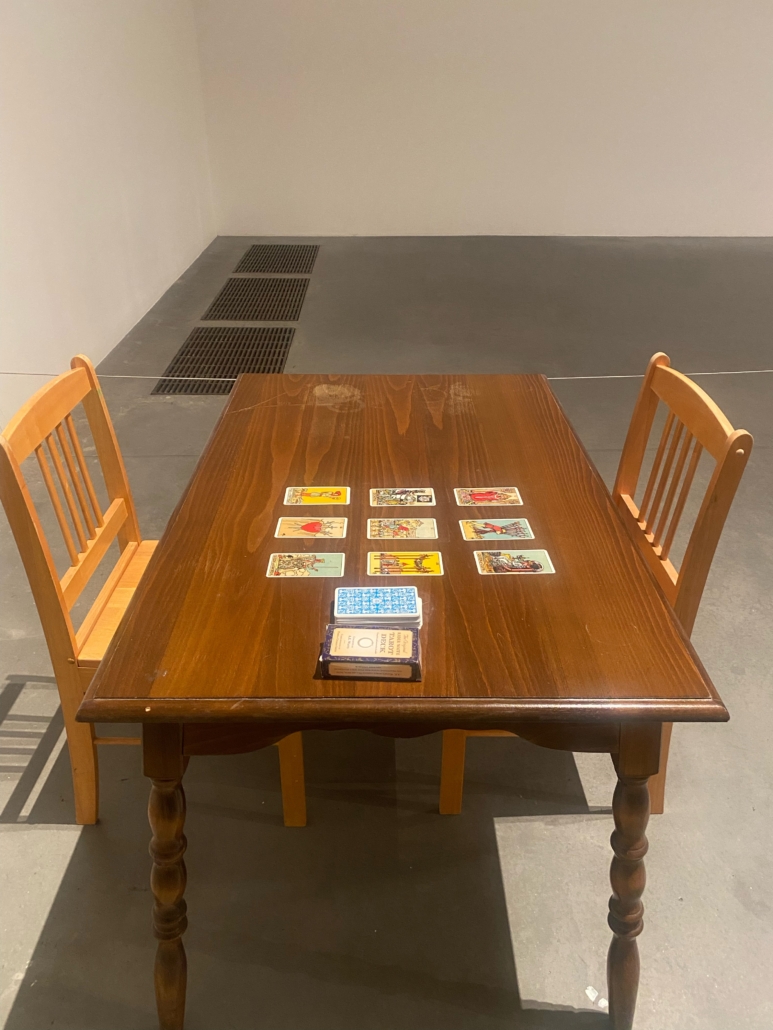
Table and Chairs with Tarot Cards | Meschac Gaba (b 1961) *
Photo: Dr Alexander Stein | Tate Modern, London | August 2026
Tempo matters here in a more particular way than speed alone. A chatbot can give the easy reading and then arrive at the interpretation that unsettles the question in the space of a single response. That later reading may even be the better one, but it can arrive as the completion of what came before rather than after an earlier interpretation has had the chance to fail. The querent does not have to live with one meaning long enough to discover that it does not fit before another arrives and reorganises it. Ansari (2026), writing about latency and paced intelligence, describes a related problem: coherence can arrive faster than it can be metabolised.
Something like this happened when the man from the earlier reading photographed his spread afterwards and sent it to a chatbot. What came back was not foolish. It caught the instability the reading had left open and the sense that the ground under one part of his life was no longer firm. In one sense, it was right. But where the reading had held two futures beside one another, the machine began gathering them into one account of where he was heading. Each card could now become another piece of the story already taking shape, until the prediction curved back on itself and seemed almost to prove its own premise.
Small distinctions disappeared first. Too much weight can bring a foundation down, but pulling it down yourself is not the same as watching someone else strike at it. A tremor felt from inside can look like collapse while the structure still stands. Around a table those forks can slow the reading down, leaving one possibility enough time to become less convincing before another replaces it. On the screen, they were gathered quickly into the story that made the most sense of them together. The card barely had time to stay a card.
The moment after an interpretation changes too. At a table, a silence does not need to be explained before it affects the reader. A chatbot receives the reaction only once some part of it becomes another prompt. The person has had to notice the reaction first and put some version of it into words. The machine may respond sensitively to what is typed, but what it cannot receive is the interval before typing, when the person may not yet know what the interpretation has done to them. This matters once an exchange has begun organising itself around one reading. Whatever the person types next becomes more material for the conversation already under way. Their response can disrupt the story, but it can also be absorbed as further evidence for it. The loop in the reading was not simply that the machine told the man what he wanted to hear. He had already given it enough of the spread and of his situation for an account to begin forming; once that account existed, what came next could be read through it.
The chatbot may also become invested with a kind of knowing that exceeds what the user consciously attributes to it. Those experiences belong to the person using it whether or not there is a corresponding experience inside the machine. The stranger question is what happens to the projection once it arrives. In the human reading, the pressure of the question can be felt by another person, imperfectly and perhaps wrongly. With the machine, the question can return transformed without another subject having had to bear its arrival. The absence of a body in which that projection can have consequences begins to matter here. An anxious question can be answered calmly without anyone having felt anxious while receiving it; a demand for certainty can be met without anyone having noticed themselves being pulled towards certainty. The machine returns language rather than countertransference. From the user’s side, this may still feel remarkably like putting something somewhere and receiving it back in a form that can be borne. The resemblance is close enough for the difference to become difficult to see.
Winnicott leaves an awkward problem here because the chatbot appears to survive extraordinarily well. It can be attacked or rejected and then summoned again in the next line, but this is an odd sort of survival. Nothing on the other side has been endangered. There is no relationship to repair and no object that has had to recover from what was done to it. The machine does not retaliate, but neither has it had to refrain from retaliation; it remains available. That availability changes the old fantasy of the oracle. Human readings end, and analysis formalizes that limit in the hour. The chatbot keeps the spread while much of the frame that would ordinarily make the encounter finite has fallen away. Even the card can refuse to become clearer, however long one stares at it. The chatbot can simply be asked again, each new prompt offering another attempt to get closer to what the question was really asking. It can therefore feel outside the self enough for its answer to have authority while remaining exceptionally responsive to whatever the self gives it next.
Something that began partly in the querent can then return with the feeling of having been found elsewhere. Tarot has always played along this boundary. The card comes from outside and is recognised from within; neither discovery nor invention quite catches what has happened. A human reader makes the boundary messier because someone else is doing some of the recognising. AI troubles it differently. The machine speaks from outside, but much of what allows the answer to sound so specifically true has come from the question and everything that has accumulated around it.
A chatbot can also keep a reading open. It can return the person to the card and ask what in the image continues to catch their attention or simply leave two readings beside one another for longer. Prock et al. (2026) describe practitioners using AI in some of these more exploratory ways, closer to another source of association than a final authority. Cheng et al. similarly describe non-oracle uses that support a user’s own self-deliberation rather than taking the judgement over. The harder part is that these uses do not announce themselves clearly. “What does this mean?” can ask to have uncertainty taken away, but it can also ask for company in uncertainty while meaning is still forming. A reader may not always know which request they are hearing, and a machine cannot safely assume it knows either.
AI tarot makes that ambiguity somewhat easier to observe. A question is handed first to an image and then to something that can answer almost immediately, and what comes back may sound more settled than the question itself has yet become.
============
[1] Naming the illustrator matters in tarot because the image is not decoration added to a meaning established elsewhere; it becomes part of what can be read. Smith had considerable freedom in imagining the Minor Arcana of the Rider-Waite-Smith deck, giving the numbered cards scenes in which figures act upon and respond to one another rather than merely displaying the suit. Later decks repeatedly borrow from or revise this visual language, giving the illustrator something closer to an authorial role in the interpretive life of a deck.
References
Ansari, S. G. (2026). Latency, Containment, and Paced Intelligence: Toward a Psychoanalytic Framework for AI Alignment. The CAI Report, Issue 10. https://apsa.org/latency-containment-paced-intelligence_i10/
Bion, W. R. (1962). Learning from Experience. London: Heinemann.
Cheng, M., Ibrahim, L., Liu, G., Lam, M. S., Padmakumar, V., Madibekov, N., Yang, D., & Jurafsky, D. (2026). LLMs as Oracles: Reliance on LLMs for Subjective Personal Questions. arXiv:2609.14849. https://arxiv.org/abs/2609.14849
Decker, R., Depaulis, T., & Dummett, M. (1996). A Wicked Pack of Cards: The Origins of the Occult Tarot. Duckworth.
Prock, M. K., Epstein, Z., Schroeder, H., Smith, A., Lee, C., Goblot, V., & Jahanbakhsh, F. (2026). Interpretive cultures: Resonance, randomness and negotiated meaning for AI-assisted tarot divination. Proceedings of the 2026 CHI Conference on Human Factors in Computing Systems. https://doi.org/10.1145/3772318.3791571
Winnicott, D. W. (1971). Playing and Reality. London: Tavistock Publications.
<><><><><><><>
* What happens when objects of spiritual and personal significance are displayed in a museum?
In this installation from Museum of Contemporary African Art, Meschac Gaba brings together over 75 objects related to various world religions and cultures. Symbols of Buddhism, Christianity, Islam, Judaism, Hinduism, Voddn and other traditional African faiths are arranged on shelves of a cross-shaped wooden structure. This room also includes a table and chairs used for Tarot card readings.
Art has long played an important role in the teaching and dissemination of religion. Gaba comments that in contemporary Benin, where he is from, most people are poly-religious: ‘Catholics brought Christianity, but for my ancestors Catholicism and Voodoo
In his museum-within-a-museum, Gaba challenges the expectations and boundaries of what’s perceived as art and as religious artifacts. We see empty beer bottles, a child’s plastic toy doll, mirrors, crystals, a piggy bank, reminding us that everyday
objects can carry spiritual significance. Removing them from their original contexts and presenting them in a gallery space, Gaba reveals the power museums have to create and dictate value. For the artist, inspiration comes from daily life, ‘because in daily life you find new things, you find traditional things, you find everything
Curated by Michael Wellen, Senior Curator, International Art and Genevieve Barton, Assistant Curator, International Art, The Gilbert de Botton Gallery
<><><><><><><>
M Grover is an organisational researcher and consultant working in systems psychodynamics. Her research examines authority, group relations, institutional mourning, and how organisations negotiate dependency, difference and uncertainty. She is completing an MA in Systems and Psychodynamic Approaches at the Tavistock and Portman. Her work has appeared in the International Forum of Psychoanalysis and Group & Organization Management, with a forthcoming chapter from Vernon Press. She is the recipient of the 2025 Maurice Burke Essay Prize from the Chicago Center for Psychoanalysis.