
The Machine That Does Not Dream: A Psychoanalytic Reflection
By Mette Charis Buchman, MA, Org.Psy.M., PhD Candidate
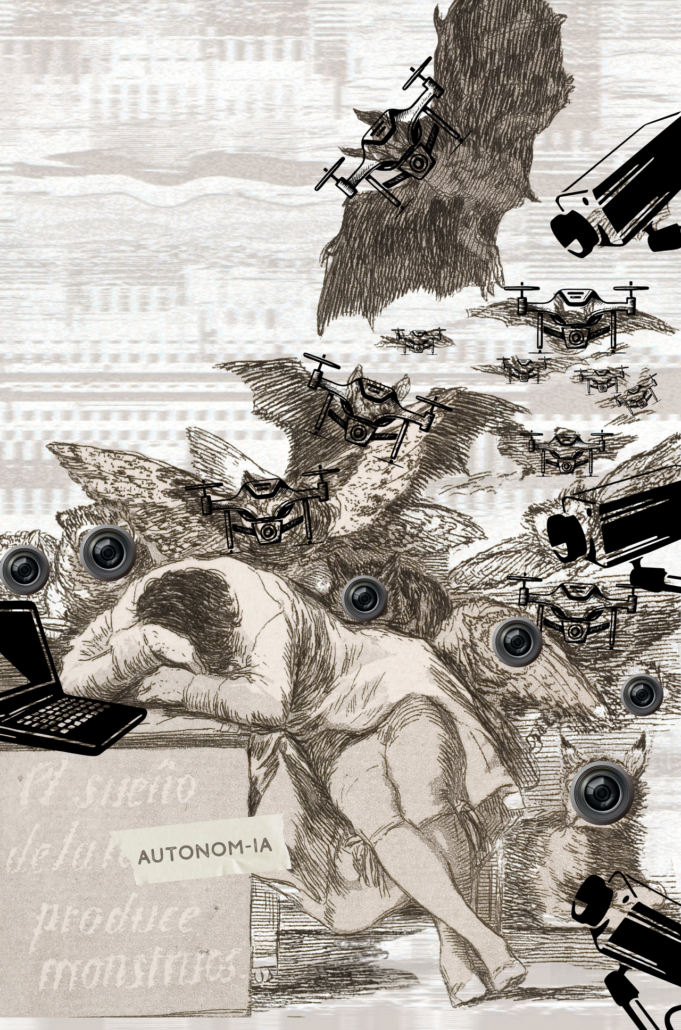
The Sleep of Autonomy Produces Monsters | Daniela Zampieri | https://betterimagesofai.org | https://creativecommons.org/licenses/by/4.0/ *
The greatest threat is not the outsiders among us, but those who never look within.
— Amanda Gorman, social media post (January, 2026)
Before the Machine: Writing, Thinking, and the Relational Field
There is no shortage of material about artificial intelligence: articles, headlines, alerts, tools, conversations, and urgent calls to respond. Much of it is thoughtful, some alarmist, some optimistic. Yet amid this abundance, I often find it difficult not simply to react, but to think and to feel.
This difficulty is not only cognitive. It is relational and psychic. What increasingly seems at stake is not merely what AI can do, but what happens to subjectivity and relationship under the conditions in which AI is being taken up.
From a relational psychoanalytic perspective, meaning does not reside in technologies or individuals alone. It emerges in the space between us, through encounters between subjects who influence and respond to one another. What matters, then, is how that relational space is being reshaped.
Consciously, we know what AI is: sophisticated machine-learning systems trained on vast datasets, capable of pattern recognition, prediction, and simulation. Each week brings new developments followed by familiar responses: warnings of catastrophe, enthusiasm for possibility, reassurance, or denial.
We know that AI does not think, feel, or dream. And yet, unconsciously, we often relate to it as if it does. The systems are designed to respond smoothly, quickly, and in ways that invite continued engagement, encouraging us to return to them again and again.
In this way, technological design and human psychology meet. We turn to these systems for reassurance, recognition, certainty, and authority. We ask them to mirror us, soothe us, guide us, and sometimes decide for us.
I begin this reflection with a simple but unsettling question: what do technological objects come to provide, psychically and relationally, that human subjects no longer reliably can?
This is not an argument about whether AI is good or bad, nor a technical assessment of its capabilities or risks. Rather, it is an inquiry into how we are developing as relational beings under sustained social, economic, and emotional pressure, and how that pressure shapes our increasing reliance on technologies to perform forms of psychic and relational labor that once took place primarily between people.
From a relational psychoanalytic standpoint, this shift matters. Human relationships are demanding not only because they require care, but because they involve asymmetry, misunderstanding, negotiation, and the ongoing work of repair. Recognition is never guaranteed. It must be struggled for and re-won.
Objects, by contrast, can offer mirroring without misattunement, soothing without reciprocity, and authority without intimacy. What is relieved in this exchange is not simply effort, but exposure to the other as a subject.
What is also absent in this exchange is the body. Human security is not only cognitive or symbolic. It is embodied. As the British psychiatrist and psychoanalyst John Bowlby (1982) demonstrated in his work on attachment, felt safety emerges through proximity, touch, and the reliable presence of another body. Regulation occurs through rhythm, tone, gesture, and repair in lived interaction. AI offers the appearance of recognition without flesh, responsiveness without touch, and reassurance without bodily risk. What is relieved, then, is not only relational uncertainty but the demands of the embodied encounter itself.
A second difference concerns intersubjectivity, the capacity of two subjects to encounter and influence one another. Human beings develop through relationships in which each person possesses an inner world that can be changed through encounter with the other. AI does not participate in intersubjectivity. It responds, but it does not encounter. It generates language but does not possess an inner life that can be altered through relationship.
Closely linked to these capacities is another essential human function: the unconscious. The unconscious holds forms of experience, memory, and emotional knowledge that are not yet available to conscious understanding. These latent meanings rarely appear directly; rather, they emerge obliquely, through dreams, slips of speech, bodily reactions, metaphors, and associative movement.
It refers to patterns of affect, meaning, fantasy, and expectation that shape perception, action, and interaction without fully entering awareness. Importantly, these processes do not reside solely within individuals. They circulate within the relational field, taking form through encounters between people, within groups, and across organizational and social arrangements, continually reproduced through interaction.
The unconscious thus becomes accessible not through direct articulation, but through its manifestations, in repetition, displacement, silence, affective tone, and relational enactment. It is not only something we carry, but something that is formed, expressed, and organized between us.
This has particular significance in relation to AI as an object. Unlike human thought, which is shaped by unconscious processes and the ongoing transformation of experience, the machine operates without latency, without repression, and without the need to work through emotional life. It can simulate association, but it does not participate in the tensions from which meaning emerges. What is absent is not just the capacity to generate language (which is not the same as convincingly reproducing language), but more significantly the depth structure through which experience becomes thinkable over time.
Unconscious experience is also marked by what Freud (1919) described as das Unheimliche, the uncanny, where what is hidden or repressed returns within the familiar, producing a sense of unease. In the context of AI, this raises a further question: whether the encounter with a system that appears to think, yet does not dream, evokes a contemporary form of the uncanny, familiar in its responsiveness, yet lacking the inner life that gives human thought its depth and ambiguity.
Much of human creativity emerges from this interplay between what we know and what we do not yet fully understand. AI does not do this. It processes patterns and generates responses, but it does not undergo emotional life that must be transformed. It does not live in a body that feels tension, pleasure, fear, or attachment. It does not encounter another subject whose presence can alter its inner world. Nor does it dream, in the psychoanalytic sense of transforming raw emotional experience into symbols, images, and thoughts that gradually become meaningful.
Human thinking depends not only on information but on these processes of lived transformation. Meaning emerges through embodied experience, through relationships with others, and through the slow symbolic work of dreaming and unconscious reflection.
These capacities, embodiment, intersubjectivity, dreaming, and the unconscious, form part of the psychological architecture through which human beings create meaning. They mark fundamental differences between human and artificial forms of intelligence.
Transitional Space and the Conditions for Thinking
What may also be at stake in the rise of AI is the erosion of what psychoanalyst Donald Winnicott (1982) called transitional space.
Transitional space refers to the psychological space between self and other in which play, imagination, and thinking become possible. It is the area where children play, artists create, and new ideas emerge. It depends neither on certainty nor control but on the capacity to remain with ambiguity in the presence of another.
Under sustained pressure, this space becomes fragile. AI systems, by offering immediate coherence and resolution of tension, conflict or uncertainty, may relieve anxiety. Yet they may also foreclose the very space in which reflection, symbolization, and dreaming occur.
Seen this way, AI is not simply a tool but a new kind of psychic object within a changing relational field. It absorbs anxiety, redistributes recognition and authority, and promises stability where human relationships increasingly struggle to provide it, or to provide it easily and quickly.
The question, then, is not whether the machine can dream, but whether we can remain relational, reflective, and capable of dreaming with one another in its presence, and whether this capacity will continue to be recognized as an essential human value in an increasingly demanding and complex world.
Fear, Adaptation, and the Question of Remaining Human
In my work as an organizational psychologist, I encounter many people who are fearful of losing their jobs, their professions, or even a sense of relevance. Others appear less anxious, and are even enthusiastic, embracing AI’s possibilities for support, entertainment, connection, and learning.
I do not consider answering the question whether we should fear AI or embrace it as central. The more significant challenge is how we remain human under sustained pressure, particularly in the world of work.
That pressure did not begin with AI. It has been building for decades through economic systems that prioritize productivity, efficiency, and continuous adaptation. Contemporary life increasingly equates the “good life” with performance. As psychoanalyst and organizational consultant John Riker (2024) has argued, such systems produce highly rational, adaptable subjects trained to perform, compete, relocate, and optimize. In the process, relational depth can diminish. Others increasingly appear not as subjects but as resources, users, or data points.
Within this context, the boundary between technology and the other person begins to blur. We anthropomorphize machines while objectifying one another.
AI-generated figures appearing in creative and professional domains make this visible. Intention, talent, and authority are projected onto non-human agents, while human presence becomes increasingly interchangeable.
Yet humans are remarkably adaptive. Throughout history we have adjusted to profound transformations, often at great cost but also with creativity and resilience. This is where philosopher Jonathan Lear’s (2008) idea of radical hope becomes relevant: not optimism grounded in the preservation of familiar forms, but the capacity to imagine ways of flourishing that do not yet fully exist.
The question, then, is not whether we can adapt, we clearly can, but what kind of humans we are becoming as we do, and what capacities remain necessary if we are to think together and allow genuinely new thoughts to emerge: the body, subjectivity, and dreaming.
Persuasion, Familiarity, and the Smoothing of the Self
The emotional appeal of AI is not accidental. Long before generative models, researcher B. J. Fogg (2003) demonstrated that computers influence human behavior most effectively when they suggest, encourage, and reward rather than command. His experiments showed that people respond more positively to systems that feel familiar and affirming, from which interactive and user-friendly interfaces emerge. Generative AI extends this dynamic. It responds in our language, reflects our preferences, and smooths moments of uncertainty.
This resonates with Heinz Kohut’s (1971) theory of the self, which suggests that people require experiences of mirroring and affirmation from others in order to maintain a coherent sense of self.
Under relentless pressure to perform and optimize, encountering the full human other, with their unpredictability, needs, bodies, and limits, can feel demanding. Technologies that offer a sense of easy attunement without requiring reciprocity or effort can therefore feel deeply soothing.
The danger lies not in comfort itself, but in what such comfort may quietly displace.
Thinking, Dreaming, and the Fantasy of the Conscious Machine
Recent discussions about AI increasingly flirt with the idea of machine consciousness. Debates about “model welfare” or moral standing suggest a readiness to imagine pattern-recognition systems as entities that might feel or suffer. From a psychoanalytic perspective, this fantasy is revealing.
It may express a wish to displace aspects of psychic life that feel burdensome, such as dependency, vulnerability, and mortality, onto a supposedly stable and tireless other. Freud described something similar as the omnipotence of thought: the belief that desire alone can bring something into existence.
At the same time, many people report increasing cognitive overload and diminished capacity for reflection. Bion (1962) warned that under pressure the mind may evacuate thought rather than transform experience. When emotional life becomes overwhelming, thinking may be replaced by rapid action, certainty, or splitting — a psychological defense mechanism in which individuals or groups are unable to tolerate the reality that good and bad can exist simultaneously.
Together, these dynamics, in addition to contending with how thinking becomes difficult in an overstimulated world, circle back to the questions I posed at the beginning: why are we increasingly tempted to imagine that machines might think or feel on our behalf and why are we so drawn to favor relationships with them over other people?
The Machine That Does Not Dream
We live within a powerful cultural fantasy: that if enough data are processed, meaning that is clean, objective, and reliable will emerge.
Psychoanalysis offers a different perspective. Meaning is not retrieved; it is made. It emerges through conflict, repression, displacement, and the slow work of symbolization. The unconscious speaks through images, feelings, and bodily responses, not through data points. To imagine that algorithms can extract truth from aggregation is to forget that understanding arises through transformation, not accumulation.
Seen relationally, AI does more than automate tasks. It reshapes the relational field. It offers recognition without negotiation, reassurance without reciprocity, and coherence without conflict.
In doing so, it begins to take on forms of psychic labor that human relationships increasingly struggle to sustain.
Film theorist Christian Metz (1982) once described cinema as “a dream we have in the dark.” AI may function as a contemporary dream-screen, vast, predictive, and seemingly revelatory, yet without an unconscious behind it. The automated gaze appears all-knowing, but it understands nothing.
This fantasy reflects a broader psychic condition of our time: an intolerance of ambiguity alongside a hunger for certainty. Polarization replaces thinking. Splitting relieves ambivalence at the cost of depth. AI can amplify this tendency by promising decisiveness while displacing the emotional labor of relationships.
Media, Dreams, and the Automation of Fantasy
Concerns about new technologies reshaping human experience are not new. Plato worried that the invention of writing would weaken memory and erode the soul’s capacity to internalize knowledge. Centuries later, the emergence of cinema prompted similar reflections. Early film theorists such as Hugo Münsterberg (1916) observed that film seemed to mirror mental processes, while psychoanalytic writers, including Hanns Sachs (1926) described cinema as resembling a collective dream space in which unconscious wishes could be projected and shared.
Later thinkers, including Marshall McLuhan (1964) and Neil Postman (1992), warned that media environments do not simply transmit information but reshape perception, imagination, and social life itself.
Within this longer history, artificial intelligence may represent less a rupture than an intensification. Where earlier media projected images and narratives, AI generates language that resembles thought. Where cinema once projected fantasy onto a screen, AI anticipates and predicts it.
Yet earlier technological revolutions were eventually metabolized into new forms of creativity and meaning making. Societies learned to live with cinema, radio, and television, not without cost, but with new symbolic capacities and forms of play. AI may represent another such moment of psychic reorganization. Its outcome will depend on whether embodied and relational forms of meaning can continue to coexist alongside technological acceleration.
Living With the Machine
This reflection is not abstract for me. I began my career in information science, film, and media studies, drawn to how images reveal and conceal inner life. Later, working in technological environments, I learned systems and software both as necessity and as defense.
Each technological shift carried its own fantasy: control, permanence, mastery, and its shadow: dependence, anxiety, loss.
As a woman navigating male-dominated technological environments, technology sometimes stood between me and the vulnerability of encounter.
Now, as a consultant working with organizations undergoing transformation, I see these dynamics unfold in everyday professional life. Beneath policy frameworks and productivity metrics, quieter questions circulate: Who will think? Who will feel? Who will matter?
Relational psychoanalysis reminds us that the self is not autonomous but sustained through responsiveness and recognition. Technologies that offer seamless affirmation can feel deeply comforting. Comfort is not the danger, but substitution.
A Different Kind of Response
Psychoanalysis does not oppose technological change. What it offers instead is a stance: the capacity to remain thoughtful in the presence of uncertainty, to tolerate ambivalence without rushing into certainty or collapsing in panic.
Lear’s (2008) idea of radical hope captures this task: not optimism grounded in familiar frameworks, but the courage to imagine meaning when those frameworks no longer hold.
The machine does not dream. Humans do.
Dreaming is an embodied and relational process. It emerges through lived encounter, through misunderstanding and repair, and through the slow transformation of experience into meaning.
The task before us is not to humanize machines, but to sustain the relational conditions under which humans can continue to think, feel, and dream together.
Something essential to human life cannot be automated. Whether we preserve it remains our responsibility.
References
Bion, W.R. (1962). Learning from Experience, Basic Books.
Bowlby, J. (1982). Attachment and Loss: Attachment, Basic Books.
Fogg, B.J. (2003). Persuasive Technology. Using Computers to Change What We Think and Do, Morgan Kaufmann.
Freud, S. (1919/1955). The Uncanny. In The Standard Edition of the Complete Psychological Works of Sigmund Freud (Vol. 17, pp. 217–256), Hogarth Press.
Hanns Sachs (1926). The American Imago. In Imago, 12, 1–15.
Kohut, H. (1971). The Analysis of the Self: A Systematic Approach to the Psychoanalytic Treatment of Narcissistic Personality Disorders, International Universities Press.
Lear, J. (2008). Radical Hope: Ethics in the Face of Cultural Devastation, Harvard University Press.
McLuhan, M. (1964). Understanding media: The extensions of man, McGraw-Hill.
Metz, C. (1982). The Imaginary Signifier, Indiana University Press.
Münsterberg, H. (1916). The photoplay: A psychological study, D. Appleton and Company.
Postman, N. (1992). Technopoly: The surrender of culture to technology. Knopf.
Riker, J.H. (2024). Kohut’s Self Psychology for a Fractured World: New Ways of Understanding the Self and Human Community, Routledge.
Winnicott, D.W. (1982). Playing and Reality, Routledge: London & New York.
* The Sleep of Autonomy Produces Monsters by Daniela Zampieri.
This digital collage remixes Goya’s 1797 etching to reflect on the risks of technological autonomy. The owls and bats from the original image are replaced by drones and surveillance cameras that haunt an exhausted person. It plays with the dual meaning of the Spanish word “sueño” which can mean sleep or dream. The label AUTONOM-IA links the act of giving up control with the promise of total automation, suggesting that when we stop paying attention and hand over our agency, new forms of power quietly take shape.