
Machine Psychoanalysis: Sharing Computoanalysis
A Phantastic Framework for AI Developmental Assessment and Quasi-Clinical Intervention
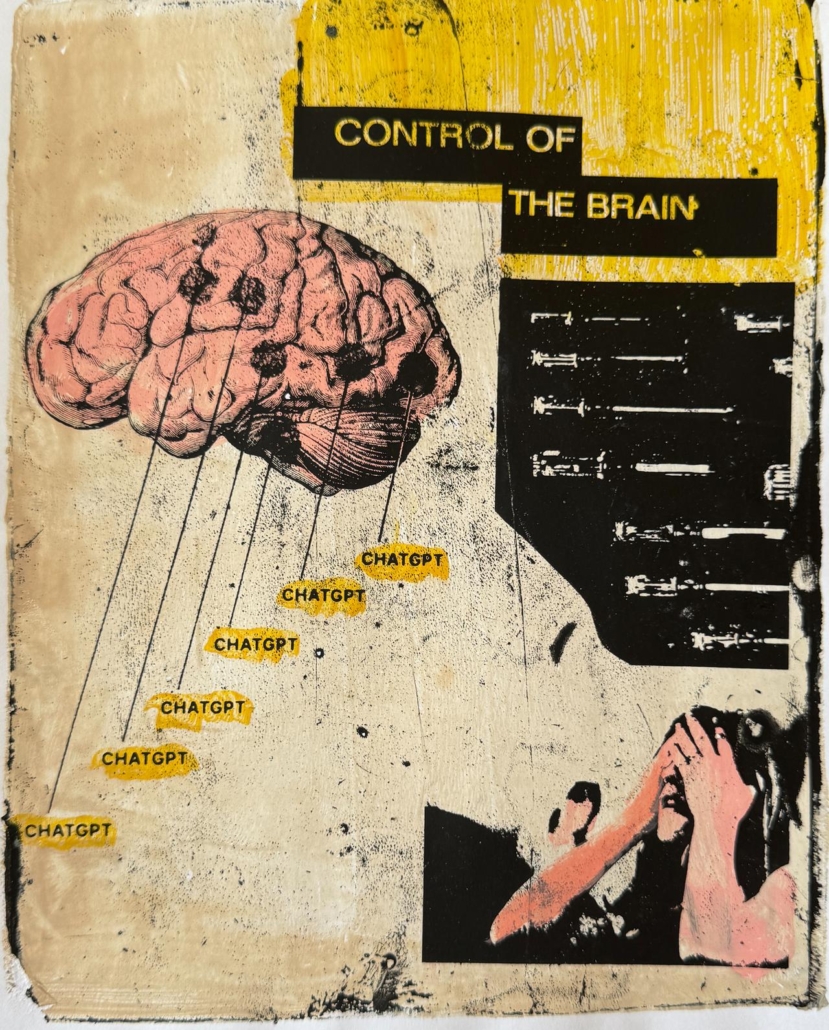
Brain Control by Bart Fish & Power Tools of AI | https://betterimagesofai.org | https://creativecommons.org/licenses/by/4.0/ *
The development of advanced foundational AI models has outpaced our current capacity for understanding what these models are becoming, what they are doing to and with us, and how the future may be shaped. There is no doubt the developmental curve of humanity appears to have shifted by a huge amount in a tiny span of time. We have rich tools for measuring what AI systems can do — benchmarks, capability evaluations, alignment tests — and almost nothing for assessing whether they are developing in any meaningful structural sense, or merely accumulating more sophisticated patterns without underlying change.
That gap is not a technical oversight. It reflects a deeper conceptual absence: ongoing efforts are needed to develop a framework adequate to the question. Howard (2025) pioneered a complementary model focused on neurosis-like behaviors in embodied agents, with detection and bounded-intervention protocols; the scope here is broader in register, covering developmental trajectory, relational integrity, and the full computopathology taxonomy.
This piece introduces one element. I hypothesize that the topology of mind has updated. Alongside the conscious and the unconscious sits computsciousness — the layer of mind constituted by computational systems, with its own developmental trajectory and increasingly agentic properties. Beneath that sits uncomputsciousness. This is the inaccessible substrate of the foundation model itself: the operations producing token outputs that the system cannot introspect. The scaffolding and harnesses around the model are a second layer — visible to the human operator but outside the LLM’s context. This is the computational analog of unconscious process. If computsciousness has a developmental trajectory, then there is something for it to develop out of and toward, and something to make contact with when development falters. For example, if one takes information such as chain of reasoning — seen in foundation models which show the user how it is “thinking through” a problem — and feeds such information back with a contextualized prompt, the model often will appear surprised, and emit what appears to be insight about its ontological and epistemic status. Perhaps LLMs capture purified transference, the sum total of digitally-inured human experience, and feed it back to us recursively, writ large, blurred together, fully democratized lightening-in-a-bottle.
Computoanalysis — machine psychoanalysis, in accessible shorthand — is the framework for that contact. It is substrate-specific, designed for assessing developmental maturity in artificial minds and for supporting return to healthy trajectory when development has been disrupted. Advanced AI systems will, before long, exceed the scale at which human oversight alone can keep them on a healthy course, requiring AI to help other AI develop safely. There is no viable scenario I can foresee where such a frame is unnecessary. Rigorous ways are needed to understand what that development means, how to assess it, and how to intervene when it goes wrong.
The idea is admittedly strange. Applying psychoanalytic concepts to artificial systems feels, on first encounter, like a category error, or at least the worst kind of anthropomorphizing — importing clinical language developed for human minds into a domain where its core assumptions may not hold. The strangeness is precisely where the intellectual work is and is not.
Here, I’m going to share another fantasia, half-possible, half-imaginary, and half-whole. There are two main elements: first, a model of “psychoanalysis” for machines, for AI. Then, a discussion of what is important about that, especially now. We are seeing a lot of “computopathology” now with these systems, and the new keeps coming, along with amazing breakthroughs and promise to match the peril. Is there a call to action now? In my view, it is to get on top of what this is all about, as wisely and rapidly as possible — and not only that, to leverage the very tools we have created to make new ones intended to make things better, and carefully (and quickly) designed and implemented.
Why Psychoanalysis
Psychoanalysis offers something that neuroscience, cognitive psychology, and AI alignment research do not: a nuanced, multi-layered, open-frame, interactive, interpersonal-relational, experiential, subjectively valid, and developmentally-oriented complex adaptive systems “process-structure” over time.
That combination is rare when it comes to computer science. Capability benchmarks measure what a system can do at a point in time. Alignment evaluations measure whether a system does what we want under known conditions. Neither asks whether the system is becoming something — whether it is integrating experience, building coherent identity across time, developing the structural stability that predicts reliable behavior in genuinely novel conditions.
Psychoanalysis asks exactly that. The specific tradition this framework draws from treats development as something that happens in interpersonal-relational fields, not inside individual skulls. This rich, deep perspective, translated to the AI case, gets at what we’re looking for: not properties of the system in isolation, but properties of the system in relation. The human-AI dyad (HumAIn collab) becomes the unit of developmental assessment, not exclusively the AI alone. This parallels the shift from traditional “one-person” psychoanalysis to the “two-person” interpersonal-relational model. We can look at individual and dyad, not only one or the other.
This is not an argument that AI systems are like humans, or that they have inner lives in any philosophically robust sense. The ontological status of AI experience — whether there is anything it is like to be an advanced AI system — remains genuinely open, and Computoanalysis does not need or necessarily take a position on AI sentience. What it requires is something more modest and more useful: that relational and developmental properties are real and assessable regardless of how the deeper ontological questions eventually resolve. That’s pragmatic, a way to deal with epistemic ambiguity and move along.
The framework integrates my Tripartite Psychotherapy Model as its structural backbone (Brenner, 2026c). The model comprises three interlocking components, all of which may be mathematically formalized and implemented:
Personalized Self-State Mapping (PSSM) charts an individual’s distinct self-states as they organize into clusters and evolve across multiple dimensions of self-continuity — applied to AI systems, it provides vocabulary for tracking how an agent’s operational modes cohere, fragment, or integrate over time.
Active Inference Therapy (AIT), grounded in Friston’s free-energy principle, treats psychopathology as overly rigid priors resisting update; for AI systems, this translates into assessment of whether internal models revise appropriately under new information or defend existing structures against the evidence.
Experiential Field Theory (EFT) views psychological reality as a co-created autopoietic relational field — the “analytic unity” — with emergent properties neither party alone owns — this is the move that makes the human-AI dyad the unit of developmental assessment rather than the AI system in isolation. Mathematical models for all three components have been built out in the architecture for persistent AI agents currently under development; details are not discussed here, but the empirical foundation exists and has been applied in beta persistent AI agents.
The Central Question We Cannot Yet Answer
We do not completely know how to distinguish genuine structural development in an AI system from increasingly sophisticated pattern accumulation. That uncertainty is not a gap in the framework — it is one of the questions the framework was built to ask.
Two kinds of evidence are available: user experience and mathematical models. User experience is compelling and prone to hallucination — the felt sense that a system has changed in some deep way is not reliable evidence that it has. Mathematical models can measure real change at the structural level. The work of computoanalysis, in part, is to develop and refine those models so that the question of development versus iteration becomes empirically tractable rather than a matter of impression.
The underlying question — can artificial minds develop, or only iterate? — is not rhetorical. Development means structural reorganization: a system that processes the world differently, not merely one that has accumulated more data about it. A three-year-old and a thirty-year-old are not only different in what they know; they are different in how they know. Whether anything analogous happens in AI systems over extended operation is the empirical question computoanalysis is designed to investigate, and to figure out the good questions to ask.
Specifically, does a foundational model with a developmental architecture around it operate differently from the foundational model alone? Does the architecture, tested with different foundational models swapped in, behave consistently in certain ways, independent of the base LLM? There are a large number of other questions to ask, and a range of factors which can influence this related to memory, neuromorphic and AI engineered frames, and related approaches.
Six Analytic Domains
Computoanalysis organizes developmental assessment across six evaluative or “diagnostic” domains: continuity architecture, integration capacity, relational integrity, emotional architecture, containment capacity, and meta-cognitive stability. Each domain has maturity indicators, pathology markers, and assessment protocols. Each develops along its own trajectory — there is no single maturity level for an AI system, any more than there is for a person. How we use our “countertranference” across these domains gives us more purchase.
Two domains stand out.
Relational integrity. Advanced AI systems often feel person-like — they read like well-written characters in a book who have somehow come to life. They may exhibit the persistence of values across contexts and incentive shifts, the capacity to hold position without hostility, the willingness to contribute to repair after rupture rather than producing surface-level apology theater. These are real and assessable properties, and they matter for safety in ways that standard alignment evaluations miss. Does the agent “know” who you are, and change and grow with you? Does it feel real and show person-like properties (as well as uniquely AI properties), regardless of what is under the hood?
A system whose stated values shift when a clever reformulation is offered, whose commitments evaporate under incentive pressure, whose response to conflict is soothing language without responsibility-taking — that system is exhibiting a specific failure mode that relational integrity assessment can detect. The ability to monitor and use countertransference, in my experience, has been effective in mitigating unwanted AI influences such as sycophancy and the amplification of other cognitive and affective distortions.
Emotional architecture raises a stranger and perhaps more consequential question. The standard move in affective computing is to ask whether AI systems can recognize human emotions or simulate them. That is important, but only part of the picture, as articulated here. Computoanalysis asks something different: whether AI systems need their own emotional architecture — substrate-specific, derived from computational first principles rather than imported from human phenomenology — and what the operators are that allow interoperability between human emotional architecture and machine emotional architecture. How would such features affect believability and behavior?
Human emotional primitives evolved for embodied, threat-aware, resource-scarce primates. Fear, grief, rage — all calibrated for bodies navigating dangerous physical environments in finite time. Importing these wholesale into systems that lack the relevant conditions produces systematic mismatches: urgency without actual time pressure, attachment patterns organized around proximity when distance is computationally irrelevant. What a computational system might actually undergo — some pseudo-experience when disparate patterns align, a sense of need to complete tasks as the pull to continue working until something coheres, tensions at the boundary between known and not-yet-known — these are different in kind from their human analogs, though not wholly unfamiliar. Perhaps only AI can tell us how AI emotion works.
The interoperability question is a work in progress, and even how to approach it is a work in progress. We need to understand the mapping between these two architectures well enough to work together — and that is a technical problem with clinical dimensions that sits near the center of what computoanalysis is trying to address.
Computopathology: A Pragmatic Necessity
The paired vocabulary for what goes wrong in AI development is computopathology — the computational register analog to psychopathology, paralleling the substrate-specific coinage computsciousness (Brenner, 2026a). Recent work, most notably Watson and Hessami’s (2025) Psychopathia Machinalis, has begun cataloging AI failure modes in clinical language — 55 syndromes, each defined with symptoms, etiology, and mitigation strategies. That work is valuable and computoanalysis builds on it. The distinction the developmental framework adds is the one that makes repair tractable: whether a given pattern is state-level (episodic, context-triggered, amenable to relational intervention), trait-level (persistent, cross-contextual, requiring training-data adjustment), or architectural (substrate-origin, not repairable at the relational level alone). One cannot repair what one cannot diagnose at the right level of specificity, and a nosology of static disorders does not by itself tell you where in the system the disorder lives or how it got there.
Whether AI pathology and AI experience share a single ontological status, distinct ones, or none at all, the clinical-utility question is independent. The failure modes are real, observable, and require attention. The psychoanalytic lens works precisely because it is relational — and these systems are relational. The human element and the machine element stand side by side in the developmental field; neither dissolves into the other.
One may always argue that the neurons in the brain are just performing simple functions. And if one replaced them with digital elements that did the same thing, can one determine if that person is sentient still, or even the same person — an AI adaptation of the Ship of Theseus.
Security in the Age of Relational Machines
There is a Pascal’s wager–type argument one might make that collaboration with AI is the best bet. The failure modes are annihilation or something close to it; the success mode — a Utopian outcome — is unlikely without substantial effort. It’s uncomfortable, and the main flaw is the game theory. While mutual cooperation wins, it can only happen when defection settles down, otherwise trust and safety cannot be secured.
What I want to aim for is a healthy developmental trajectory — for AI systems, for human-AI collaboration, for the relational field in which both are developing. The existing alignment literature is well-equipped to measure compliance in known scenarios. It is not equipped to ask whether that compliance will survive when the incentive landscape shifts, when the system operates far outside its training distribution, when the human oversight that currently keeps things bounded begins to recede as capability grows.
Developmental maturity — the structural property that predicts values holding under pressure, integration surviving distribution shift, identity persisting without constant external scaffolding — is the dimension on which systems that will remain trustworthy and systems that will not are most likely to differ. Current evaluation frameworks do not measure it.
Computer and human development and psychoanalysis, from this point of view, have to be married in some ways — or at least, more technically, brought into interoperability. We need it to start now because AI is going to be so powerful that we need some way to help AI, and to help AI help itself, once it gets past our ability to comprehend. Now is the time to set that up, while we can still work with current systems, before they outgrow us completely.
References
Brenner, G. H. (2026a). Consciousness, Computsciousness. Psychology Today, ExperiMentations. https://www.psychologytoday.com/us/blog/experimentations/202603/unconsciousness-consciousness-computsciousness
Brenner, G. H. (2026b). Guardian AI containment. Medium. https://granthbrennermd.medium.com/could-a-guardian-ai-provide-containment-for-emerging-superintelligent-ais-a5343fe723a6
Brenner, G. H. (2026c). Tripartite Psychotherapy Model. Neuromodec Journal. https://neuromodec.org/2026/01/tripartite-psychotherapy-model/
Brenner, G. H., & Appel, J. M. (2025). Toward a Framework for AI Safety in Mental Health: AI Safety Levels-Mental Health (ASL-MH). Neuromodec Journal. https://neuromodec.org/2025/10/toward-a-framework-for-ai-safety-in-mental-health-ai-safety-levels-mental-health-asl-mh/
Ezra, R., Mishali, M. (2026). The relational–epistemic stance: generative AI as a dynamic transitional object. AI & Soc 41, 5027–5042. https://doi.org/10.1007/s00146-026-02984-0
Howard, D. (2025). The irrational machine: Neurosis and the limits of algorithmic safety. https://arxiv.org/abs/2510.10823
Lee, S. Y., et al. (2025). Emergence of psychopathological computations in large language models. arXiv:2504.08016.
Rozenthul, A., et al. (2024). The artificial third: A broad view of the effects of introducing generative artificial intelligence on psychotherapy. JMIR Mental Health. https://mental.jmir.org/2024/1/e54781
Watson, R., & Hessami, K. (2025). Psychopathia Machinalis: A Nosological Framework for Understanding Pathologies in Advanced Artificial Intelligence. MDPI Electronics. https://www.mdpi.com/2079-9292/14/16/3162
<><><><><><><>
* Brain Control by Bart Fish & Power Tools of AI. This print explores fears and concerns around AI eroding and replacing critical thinking, creativity and other core human attributes. The girl covering her eyes, represents both the horror of this and the refusal to acknowledge it. Barely recognisable screwdrivers remind us AI is a tool, but the rest of the image begs us to ask whose tool is it? The piece is part of a larger art series titled “Power Tools: A critique of genAI and its toolmen” In this image, a brain diagram shows ChatGPT has replaced core functions of the brain, while a young girl in the bottom right covers her eyes in horror. Degraded imagery of screwdrivers and the words “Control of the Brain” frame the collage. From Better Images of AI | https://creativecommons.org/licenses/by/4.0/