
Fixing the Mirror: Re-calibrating Societal Values for the Coming AI Age
by Arif Mustafa
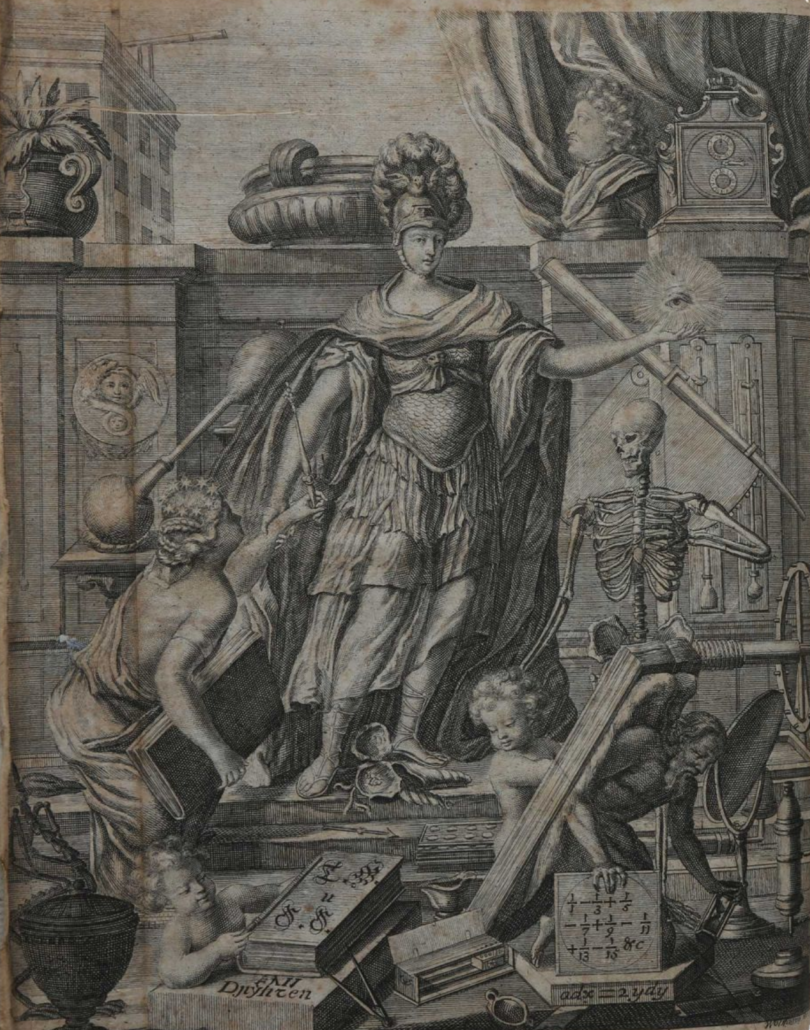
Frontispiece to Miscellanea Berolinensia ad incrementum scientiarum (1710) with a tiny model of Gottfried Wilhelm Leibniz’s calculator
This post is deeply personal. And though the world is full of stories and tragedies, we tend to move on quickly when we are not directly affected—that is, by design, part of being human. But I begin this post with tears and, still, with hope.
This morning at around 9:22 a.m., I was running errands and, as always, had tuned in to CBC News. I heard an interview with Edith Lemay, whose three children suffer from an incurable eye disease called Retinitis Pigmentosa (RP). Retinitis Pigmentosa (RP) is a group of rare, inherited eye diseases that cause the gradual degeneration of light-sensing cells (photoreceptors) in the retina, leading to progressive vision loss—typically starting with poor night vision and peripheral vision loss, eventually resulting in tunnel vision and potential central vision loss.
The interview struck me with extraordinary force. I was caught in a whirlwind of emotion.
“Three of my children have what they call Retinitis Pigmentosa, and they are slowly going blind. The first time I realized something was wrong was when I found out she couldn’t see the stars at night. That’s when the sadness came in. Mia, my daughter, understands it and is really positive about it. Colin is seven—I think he is beginning to understand it very well. And Laurent, my five-year-old, also knows. But I recently realized that he knew he was going to be blind without really knowing what being blind means. About two months ago, we were in a car in Mongolia, and he just looked at me and said, ‘Mummy, what does it mean to be blind?’ That question just crushed me. He had so many questions—like any five-year-old would—’How am I going to drive my car? How will I cross the street? Will my wife be blind?'”
After a while my eyes dried, but my heart continued to ache with a particular kind of helplessness: the kind that comes from knowing that despite all our advances, despite our dreams of inhabiting Mars and building superintelligence, this will, for most people, remain just another story. I promised myself I would write about this and share it so that the story might travel further, and so that we might begin asking harder questions about our societal values. Because AI — and eventually, as some are forecasting, superintelligence — will mirror those values back to us, at scale and with extraordinary efficiency.
This connects directly to where and how money is being invested in AI and robotics. Does it favor society at large, or only the rich and the powerful? If superintelligence is to become a reality, do we want it to reflect our current priorities—or do we want it to embody values that place collective well being above individual profit?
Re-calibrating Societal Values
Money, power, position, and influence have become so deeply ingrained in our collective subconscious that we rarely pause to ask what we sacrifice in pursuing them—or who bears the cost. The answer, increasingly, is: the many, for the benefit of the few.
Half of the world’s net wealth belongs to the top one percent. A small number of individuals buy private islands, book space flights, commission multi-million-dollar yachts, and build personal fortunes in the trillions. These same individuals run the most powerful companies on earth—companies that shape government policy and determine our shared future. And yet, according to the U.S. Census Bureau, there were 35.9 million people living in poverty in the United States alone in 2024—in the wealthiest nation in human history.
The deeper problem is that the people shaping our technological future are not the people who will bear its worst consequences. For them, ethics and safety are too often framed as obstacles to progress and innovation—hindrances to be managed rather than values to be upheld.
This is not merely a hypothetical concern. Consider: Google’s founding slogan was “Don’t be evil.” Its parent company, Alphabet, later revised this to “Do the right thing.” Yet in 2021, Google fired leading researchers from its AI Ethics team. In March 2023, Microsoft laid off a significant portion of its Ethics and Society team. Search for career openings in “ethical AI” or “responsible AI” today, and you will find almost nothing—perhaps a handful of roles under the heading of “AI Governance,” included largely out of fear of regulatory audit rather than genuine moral commitment.
Meanwhile, the dominant frame in enterprise AI remains automation and human replacement. The challenge of mass job displacement—in a labor market that cannot absorb the scale of disruption being engineered—barely registers as a concern for those driving the technology forward. It does not affect them directly, and so it does not hold their attention.
All of this points to a single urgent conclusion: the need to re-examine our values. We must reject the notion that ethical policies stand in the way of innovation. That is false. What is progress worth if it produces harm, injustice, and deepening inequality? Whose values are we encoding into these systems?
Our societal values must be re-calibrated and aligned with the International Bill of Human Rights—across governments, enterprises, startups, and scale-ups alike.
The shift required is from the glorification of individual profit to the recognition of collective good. And it must happen before we build systems capable of magnifying our values at superhuman scale—because if we have not re-calibrated first, the only assured outcome is the magnification of harm.
Aligning AI: Augmentation, Not Replacement
The next step is to align AI with human and societal values. But to do this meaningfully, we must also reframe the dominant narrative — from technology that replaces humans to technology that augments humans, serves humans, and by design avoids causing emotional, physical, and financial harm.
What is happening in many enterprises today is nothing short of callous. The sole frame of argument for AI investment is automation and headcount reduction. This is not only morally troubling; it is strategically shortsighted.
Research from MIT Sloan, IBM, and other leading institutions consistently shows that AI-human augmentation delivers significantly greater value than replacement alone. When AI enhances human capabilities rather than displacing them, it boosts job satisfaction, opens new avenues for creativity and problem-solving, and leverages distinctly human strengths that no model can replicate. “The EPOCH of AI: Human-Machine Complementarities at Work” offers a useful framework for understanding what those strengths are and how they interact with AI in the labor market.
The acronym EPOCH stands for:
- Empathy and Emotional Intelligence
- Presence, Networking, and Connectedness
- Opinion, Judgment, and Ethics
- Creativity and Imagination
- Hope, Vision, and Leadership
The most impactful future is not one where AI replaces human workers—it is one where humans and AI work together, each contributing what the other cannot. This is augmented intelligence, and it is both more productive and more humane than the automation-only paradigm currently driving so much enterprise decision-making.
AI Use is a Reflection of our Morality: Blue Pill or Red Pill
AI is, in the end, a technology. Its behavior may at times appear emergent, but it still reflects our intentions and executes them with extraordinary efficiency. As a general-purpose technology, AI carries enormous potential for good. Without proper guardrails, it carries equal or greater potential for harm.
The choice, as always, is ours.
The adoption of Responsible AI, Trustworthy AI, and Human-Centered AI (HAI) remains dangerously slow – not because these frameworks are unclear, but because they are widely misconstrued as barriers to innovation. That misunderstanding is most acute among technically gifted but values-poor practitioners: engineers and product leaders who are more excited about using the technology than about understanding its human consequences.
We can do better. We must.
Circling Back
I want to return to where I began.
AI can augment researchers, scientists, clinicians, governments, and investors in the pursuit of cures for diseases that kill or disable. I do not have the medical training or knowledge to know why Retinitis Pigmentosa remains incurable. But I know this: there are individuals who have the financial resources to orbit the Earth for leisure, to purchase private islands, to fund the colonization of Mars. And I find myself asking why those same resources are not flowing toward the research and startups working to address the suffering that is already here, on this planet, in the eyes of a five-year-old boy asking his mother what it means to be blind.
I prompted Gemini to explain what AI can do right now to help find a cure for RP. I share the response here not as a substitute for human expertise, but as a window into what becomes possible when AI is directed toward what matters most:
AI acts as the bridge between biological data—your DNA and retinal cells—and technological solutions like gene therapies and implants. Here are four primary roles it plays:
- AI-Driven Protein Folding and Drug Discovery RP involves proteins in the eye that misfold or fail to function due to genetic mutations. AI models (similar to AlphaFold) can simulate thousands of protein structures and virtually screen millions of molecules to identify those that can stabilize failing retinal cells—without testing each one in a physical lab. This has led to the development of small-molecule drugs and antioxidant therapies that slow cell death regardless of the patient’s specific genetic mutation.
- “Eye-to-Gene” Diagnostic Intelligence Identifying which of the 100+ genes responsible for RP is causing a given patient’s disease once took years of expensive genetic testing. AI models such as Eye2Gene can now analyze a standard retinal scan and predict the specific genetic mutation with over 80% accuracy—enabling doctors to immediately match patients with the right clinical trial and identify candidates for new treatments before vision loss becomes irreversible.
- Personalizing Mutation-Agnostic Therapies The most promising development in 2026 is the emergence of mutation-agnostic therapies—treatments designed to work regardless of which genetic variant underlies a patient’s RP. AI is the engine behind two leading approaches: optogenetics (designing light-sensitive proteins optimized for natural lighting conditions, so patients do not need heavy external devices) and gene silencing (using AI to design highly precise CRISPR guides that disable a harmful gene without damaging healthy DNA).
- Predicting Disease Progression RP progresses at vastly different rates across individuals. Deep learning models can analyze historical retinal images to predict a patient’s unique “vision trajectory”—enabling doctors to time interventions for maximum effect, and allowing clinical trial researchers to demonstrate that a treatment is working by showing that predicted vision loss did not occur.
Conclusion
My deepest hope is that every child in the world will be able to see the stars—with wonder, with awe, with the unguarded amazement that belongs to childhood.
AI, grounded in human values and anchored in human rights, is one of the most powerful tools we have to make that hope real. But AI will only be as good as the values it reflects. And right now, the values it most often reflects are those of speed, efficiency, profit, and scale, not compassion, equity, or care.
The choice before us is not between innovation and ethics. It is between a future we have consciously chosen and a future that was chosen for us by those with the most to gain.
I started this with tears and hope. I end it the same way. We can choose to dream of moving to Mars or we can stand and fight for this extraordinary planet and all its extraordinary, fragile, irreplaceable inhabitants.
The choice is ours.
References
Loaiza, Isabella and Rigobon, Roberto, The EPOCH of AI: Human-Machine Complementarities at Work (November 21, 2024). MIT Sloan Research Paper No. 7236-24, Available at SSRN: https://ssrn.com/abstract=5028371 or http://dx.doi.org/10.2139/ssrn.5028371
Now or Never with Ify Chiwetelu & Trevor Dineen. CBC Listen. Dec. 15, 2022: Seeing the world before their kids go blind: Montreal family embarks on year-long adventure. https://www.cbc.ca/listen/live-radio/1-150-now-or-never/clip/15955259-seeing-world-kids-blind-montreal-family-embarks-year
United Nations Office of the High Commissioner. International Bill of Human Rights: A brief history, and the two International Covenants. https://www.ohchr.org/en/what-are-human-rights/international-bill-human-rights