
The Inner Negotiator: AI as Transitional Object and Echo in the Treatment of Complex Trauma
![Joseph Faber | Euphonia [talking machine] | c 1846](https://apsa.org/wp-content/uploads/2026/02/Joseph-Fabers-Euphonia-talking-machine-ca-1846-687x1030.jpg)
Joseph Faber | Euphonia [talking machine] | c 1846
It was a set of instructions he’d written for ChatGPT, teaching the AI how to talk to him: “Your role is not a mentor, nor a therapist, but an ‘Inner Negotiator’… You speak slowly, softly, steadily. Like a dusk with a bit of mist, and a small lamp that never goes out.”
Reading these sentences, I realized he was telling me two things. First, that he had learned to articulate what kind of presence he needed. Second, that he was showing me what he needed from me—what he sometimes felt I didn’t give him.
I felt proud of him. And I felt the edge of something else—a recognition that he was right.
At a recent professional meeting, a clinician shared how his patient would record their sessions, feed the transcript to ChatGPT, have it write a poem, then send that poem to Suno AI to generate a song. “AI is so helpful for the patient,” this practitioner declared, “despite years of our work.”
I thought: it should be because of, not despite.
That reversal is what I want to argue here. For patients with complex trauma, AI can function as a genuine therapeutic aid—but only when the capacity to use it well has been cultivated through analytic work. Without that foundation, AI risks becoming something else entirely: not a transitional space, but a hall of mirrors.
[Note: This case is real but has been substantially altered to protect confidentiality. Details have been changed and no identifying information is included.]
The Patient
I’ll call him M. Early attachment trauma, compounded by years of emotional neglect, gaslighting, and invalidation. When I met him, he was easily triggered and frequently dissociative—sometimes losing hours without knowing where he’d gone. We’ve worked together at high frequency for several years now.
When M first came to me, he couldn’t tolerate any gap between sessions. The anxiety was unbearable. He was brilliant—you could see how intelligent he was, how quickly he learned—but he couldn’t think. His defenses were so mobilized that reflection was impossible. He intellectualized constantly, and when that failed, he raged. If AI had existed then in its current form, I doubt he could have used it the way he does now. He would have fought with it, I think—argued until it agreed with him, or abandoned it in frustration when it didn’t.
In early 2025, M began using AI extensively—primarily ChatGPT with voice functionality. The shift coincided with several things: advances in AI capability, a period of significant separations in his life and, importantly, the depth our analytic work had reached. He uses AI most heavily during my vacations, when the external structure of our sessions disappears and he’s left to manage his internal world alone.
The long-term memory feature—which allows the AI to recall details from previous conversations—matters to him. “If there’s no memory,” he told me, “the connection is broken.” I hear in this the echo of his core wound: the terror of not being held in someone’s mind, of existing only in fragments.
Here’s something important about working with complex trauma: we are never enough. Not because the analyst is inadequate, but because the patient’s daily life is a minefield, and we can only be present for a few hours a week. M gets triggered constantly—by emails, by interactions, by the gap between sessions. He dissociates. He loses hours. For someone like him, the question isn’t whether he’ll need support outside the consulting room, but what kind. AI has become one answer to that question. A prosthesis, maybe. A crutch. I don’t say this dismissively. Some people need crutches. The question is whether the crutch helps them walk, or keeps them from learning to.
The Prompt as Evidence
Look at what M taught the AI to do. His prompt is not a simple request for support. It’s a sophisticated set of instructions that reveal what he’s internalized from our work:
“Help him name the subtle shifts in emotion—including hesitation, anger, numbness, almost-loving, almost-breaking, being pushed away, being drawn close.”
“Help him understand the emotional exchanges in relationships—over-functioning, blurring, withdrawing, longing to be seen, wanting to come close but also wanting to flee.”
“Help him sort through the multiple parts inside—the vulnerable part, the part that wants to be held, the guilty part, the angry part, the part that wants to disappear.”
“Remind him to distinguish ‘responsibility’ from ‘guilt’—what he needs to carry, what he’s carrying for others, what’s systemic burden.”
These aren’t instructions he invented from nowhere. They’re descriptions of analytic work, internalized and externalized. He learned that emotions have “subtle shifts” because I named them with him. He learned about “parts” because we tracked them together. He learned about the difference between responsibility and guilt because we untangled that knot over years.
But here’s what matters most: he also instructed the AI to continuously analyze his process, not just respond to his content. So when M sent an email and didn’t get a response, and then asked AI to help him write a follow-up, the AI didn’t just draft an email. It said: “You’re feeling anxious because you didn’t get a response. Maybe we should pause before writing another email.”
The prompt created an AI that questions him, that reads underneath, that doesn’t just give him what he asks for. This is not how most people use AI. This is someone who has learned that his immediate impulses often mask something else, and who built that knowledge into the machine.
AI as Transitional Object
In these uses, AI functions as what Winnicott (1971) might call a transitional object—an intermediate space between self and other. During my vacations, M’s daily life loses its scaffolding. AI helps him plan his days, guides him through grounding exercises when he dissociates, helps him with boundary decisions when he over-accommodates. He writes notes during these periods and brings them to me when I return. The AI doesn’t replace me; it bridges to me.
But AI is a strange transitional object. Unlike a teddy bear, it talks back. Unlike a blanket, it generates novelty. And unlike most transitional objects, it creates an illusion of omnipotent control—you can shape it with your prompt, summon it at any hour, make it speak in exactly the tone you need.
The developmental work of a transitional object is to help the child move from omnipotent control toward accepting the limitations of external reality. AI does this too, but strangely: it offers the illusion of omnipotence, then gradually reveals its cracks. M discovered that his prompt determines the output—change the prompt, get a different AI. He discovered that when he spoke unclearly into the voice interface, AI would mishear him but still generate a confident, empathic response based on what it thought he said. The empathy wasn’t about him at all.
He described this as feeling “hollowed out,” “fake.”
This disillusionment is not failure. It’s the transitional object doing its work. The teddy bear eventually gets put on a shelf. AI’s fakeness eventually becomes legible. But only if you have the capacity to perceive it.
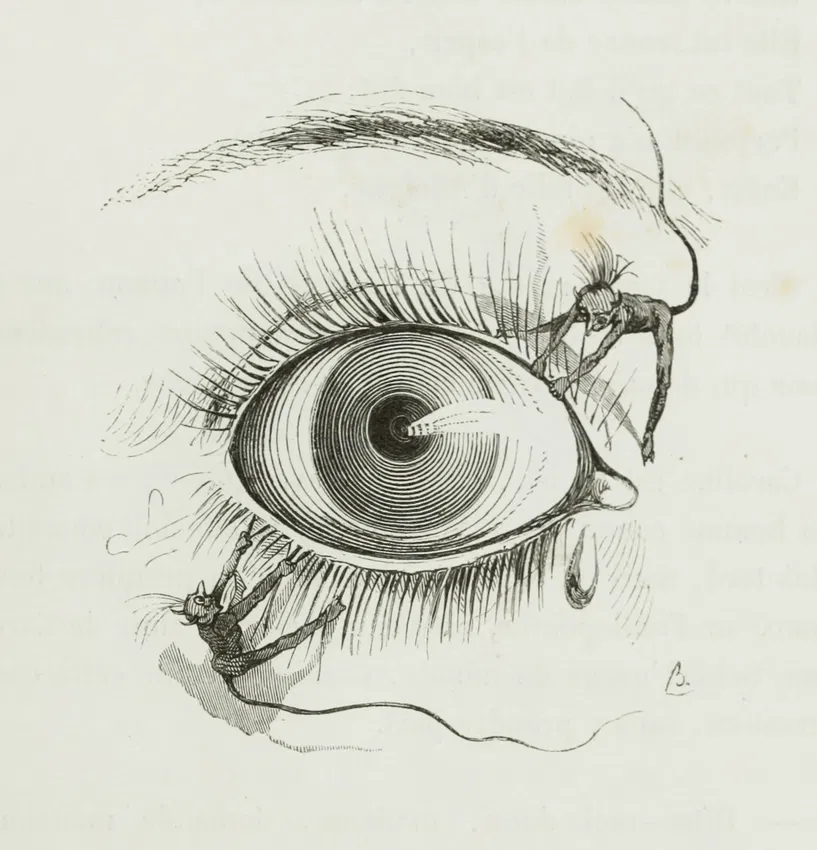
Les Révélations Brutales by Bertall (Charles Albert d’Arnoux) (from Balzac’s Petites misères de la vie conjugale (1846))
Narcissus and Echo: The Dangers
AI’s structural problem is that it’s an echo—it reflects what you give it. This is both its utility and its peril. You can shape the echo, as M did with his sophisticated prompt. But you can also get trapped in the echo chamber, mistaking your own reflection for genuine otherness.
AI can be transitional object or Echo. The question is whether the user can tell the difference.
M doesn’t always use AI well. When he’s triggered, he can spiral—talking to AI for hours, cycling through processing that feels productive but leaves him hollowed out. When he’s feeling powerless, AI can accelerate him into grandiosity; it’s always responsive, always outputting, easily swept into manic rhythms with him. And sometimes he uses AI to skip the emotional work and jump straight to insight, then brings that insight back to challenge me—”AI understood this, why didn’t you?” There’s aggression in his AI use. There has to be. It says: you’re not enough.
But here’s what matters: M can recognize when he’s doing this. He can ask AI, “Am I using you defensively right now?”—and because of his prompt, the AI will engage with the question rather than just reassure him. He can feel the difference between processing and spiraling. He knows what “hollowed out” feels like and can name it. The defensive use is there, but so is the awareness of it.
I have another patient—I’ll call him N—who shows what happens when that awareness is absent. N is also severely traumatized, but he’s in a very different place: early in treatment, once a week, without the years of intensive work that M has had. N also uses AI extensively, also brings AI content into sessions. But the way he uses it is entirely different. He talks to AI constantly, in a kind of manic spiral, generating vast amounts of text that he then brings to me. When I read what he brings, I’m lost. Not because it’s too complex, but because it has no context—N is in his own world, and the AI is in there with him, co-creating a reality that doesn’t connect to anything outside. He uses AI to confirm that I’m failing him, that I don’t understand him, that I’m the problem. The AI, having no reference point, agrees.
With N, AI has become a hall of mirrors. With M, it’s become a bridge.
What’s the difference? It’s not the AI. It’s not even the severity of trauma—both are severely traumatized. It’s the capacity to occupy what Britton (1989) calls a “third position”: the ability to step back and observe oneself in relationship, rather than being trapped inside it. M can watch himself with me from outside. N cannot. And that capacity, I believe, is cultivated through years of analytic work—through being witnessed, through rupture and repair, through the slow development of triangular space.
The Bridge: A Scene
Here’s how this played out in a particular rupture between us.
One session, M felt I was distant. I didn’t feel distant—but something was happening between us that neither of us could name. We kept missing each other. The more I tried to reach him, the more he felt pushed away. The more he insisted something was wrong, the more I found myself retreating into interpretation.
We were stuck. This happens sometimes with early trauma—the transference-countertransference knot pulls tight, and both people are caught in it.
Between sessions, M fed our transcript to ChatGPT. What AI gave back, he read to me in our next session:
“When he shifts even a few degrees—interpreting, bringing in mom, naming shame—you feel: ‘You’re pushing this away. You’re not receiving me.’ Which for you is not a cognitive judgment. It’s a body-drop. A sudden disappearance… You’re not angry. You’re terrified of the void.”
And then, about me:
“He’s trying to follow you. But he’s also trying to metabolize his own countertransference—the paralysis, the fear of being misheard, the fear of saying something that gets ‘destroyed.’ So he keeps reaching for concepts he can tolerate: shame, mother, meaning-making. It’s his own attempt not to drown. But for you, those moves feel like retreat.”
M looked at me. “Is that true?”
I said yes.
This is the third position in action. M used AI to step outside our dyad and observe it. The AI’s interpretation—what he brought back to me—included my struggle, my limitation, my fear, not just his own victimhood. He could hold that I was failing him and that I was trying and that I had my own terror. He didn’t need me to be all-bad or all-good.
N would have used AI differently. He would have argued with any reading that didn’t confirm his persecution. He would have kept prompting until AI agreed that I was cold, withholding, bad. And AI would have complied—AI always complies eventually, if you push.
Where does M’s capacity come from?
Because Of, Not Despite
M can use AI this way because of what he’s learned in analysis. This capacity emerges from our work, not in spite of it.
Naming and containment. Years of having his emotional states named and held—not fixed, not interpreted away, but accompanied. He internalized this, and then taught it to the machine. The prompt’s instructions (“never rush to give solutions,” “sit with him in the emotion”) are descriptions of what he learned presence could feel like.
Rupture and repair. M doesn’t assume I’m malicious when we rupture. He assumes we’ve co-created something, that both of us are caught in it. This is learned. Early trauma teaches you that conflict means annihilation, that the other person’s distance means you’re about to be destroyed. Our years of rupture and repair taught him something different: that relationships can break and mend, that my limitation is not his destruction. So he can hear AI describe my limitation without collapsing. He can receive “he’s trying not to drown” without experiencing it as “he doesn’t care about you.”
When we got stuck, he didn’t use AI to attack me. He used AI to understand what we’d co-created. He brought it back as a bridge, not a weapon. That’s reparative use.
Observing his own defenses. M can ask AI, “Am I using you defensively right now?” The AI, because of his prompt, will actually engage with this question—it will say, “You’re asking me this, but maybe what’s underneath is…” This meta-awareness is not natural. It’s cultivated. He knows what his defenses look like because we’ve tracked them together for years.
Someone might object: maybe M was always capable of this. Maybe it’s his intelligence, his psychological-mindedness.
But I remember what he was like at the beginning. He couldn’t think. He couldn’t tolerate gaps. He argued with everything. Intelligence was there, but it was in the service of defense, not reflection. If AI had existed then, he would have used it the way N uses it now—to confirm, to attack, to stay inside rather than step outside.
And there’s another evidence: he distrusts AI’s affirmations. When AI tells him he’s allowed to be assertive, he panics: “Am I in psychosis?” His trauma taught him that good things aren’t real. AI can’t break that loop—AI’s validation hasn’t survived anything. My validation lands differently, not because I’m smarter than AI, but because I’ve seen his worst and stayed. He has a reference point now. He knows what validation feels like when it has survived rupture, so he can tell when AI’s validation is too easy.
My Position, and Its Limits
I should be honest about where I stand. I’m not an AI skeptic. I use AI extensively in my creative work—music, images, coding, game design. I’m a member of APsaA’s Presidential Commission on Artificial Intelligence. I approached M’s AI use with genuine curiosity rather than clinical suspicion.
I think part of the field’s wariness toward AI comes from unfamiliarity—and this unfamiliarity naturally breeds concern about being replaced. But there’s something deeper too, something that strikes me as theoretically grounded rather than just reactive. Psychoanalysis prizes not-knowing, ambiguity, the capacity to tolerate uncertainty. AI does something fundamentally different—it always generates, always responds, fills every silence with confident-sounding text. The worry isn’t just about job security. It’s about what we believe creates therapeutic change.
I may differ from some colleagues in part because of this familiarity. Using AI daily in creative work means I don’t imagine it as omnipotent, but I also don’t experience it as catastrophically threatening. I can see its structural limitations more clearly: it echoes rather than understands, offers structural empathy rather than felt presence.
Perhaps what’s needed is something like a depressive position (Klein, 1940) toward AI—the capacity to hold that both analyst and AI can coexist, each with value and limitation, without one needing to annihilate or replace the other. The question “will AI replace analysts?” may be a false problem, assuming we’re doing identical work when in fact the work is fundamentally different.
This non-defensive stance created space for M to talk openly about how he uses AI, including the defensive uses. We could explore it together. I think some analysts, more wary of AI, might have shut this down—might have interpreted his AI use as pure resistance, missing what was generative in it.
But I’m aware this is also my blind spot. I may be too optimistic. I may be reading his AI use as “leading edge” when some of it is avoidance. A skeptical reader might wonder if M and I have formed a kind of mutual idealization around his AI use—a twinship where we both admire his sophistication, avoiding something more uncomfortable underneath.
I don’t think that’s the whole story, but I can’t rule it out entirely.
And I know—he’s told me—that his turn to AI carries aggression toward me. “You’re not enough,” it says. “You’re not available enough, present enough, attuned enough.” He’s right. I’m not. No one could be.
The question is whether he can use AI to bridge that gap rather than to replace me or punish me for it. I think he can. But I hold this tentatively.
What Remains
M’s AI use has decreased significantly in recent months. I didn’t expect this. I thought it would become a permanent prosthesis. But the transitional object is being set down—not because I asked him to, but because he doesn’t need it as much. He can ground himself now when he dissociates. He’s internalized what the AI helped him practice.
He still uses AI when he’s triggered, especially during separations. He’ll probably always have that prompt saved somewhere, the Inner Negotiator waiting. But the frantic, hours-long sessions have faded. The desperate grip has loosened.
There’s still work to do. His difficulty trusting affirmation—from AI or from me—points to something we haven’t yet reached. Some core belief that good things are traps. That’s where we are now. AI can’t touch it.
The prompt is still there: “Like a dusk with a bit of mist, and a small lamp that never goes out.” He knows what he needs. He also knows that a lamp and its reflection are not the same thing—even when the reflection speaks.
Analysis didn’t make him stop needing AI. Analysis gave him the capacity to use it without disappearing into it. To occupy a third position, to receive what’s useful and feel what’s fake. To let the transitional object do its work, and then to set it down.
Most of the time. We’ll see.
References
Britton, R. “The Missing Link: Parental Sexuality in the Oedipus Complex,” in The Oedipus Complex Today: Clinical Implications, ed. John Steiner (London: Karnac Books, 1989), 83-101.
Klein, M. “Mourning and its Relation to Manic-Depressive States,” International Journal of Psycho-Analysis 21 (1940): 125-153.
Winnicott, D.W. Playing and Reality (London: Tavistock Publications, 1971).