
From the Editor
by Alexander Stein, PhD
Issue 8 | November 2025
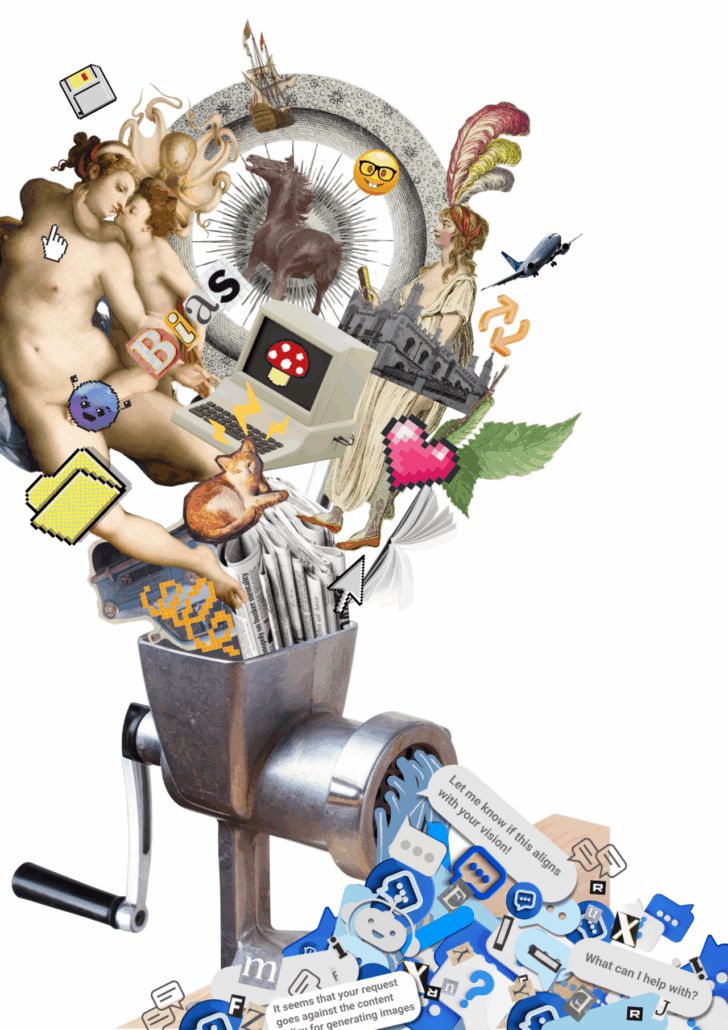
Ground Up and Spat Out by Janet Turra & Cambridge Diversity Fund *
https://janetturra.wordpress.com/ |
www.race-equality.admin.cam.ac.uk/university-diversity-fund |
https://betterimagesofai.org | https://creativecommons.org/licenses/by/4.0/
Welcome to Issue 8 of The CAI Report.
Dear Dr. Danielle, our regular human-AI relationship advice column, returns. Dr Danielle responds to a letter from Not a Bot who wants clarity on just how dangerous or potentially useful it is for AI chat agents to be providing psychotherapy. It’s a question for our time, unthinkable only a few years ago, which Dr Danielle tackles head-on. Read on and then ask yourself: what do you think—and feel—about this issue?
And if you’re motivated to engage with our resident expert on any of the fears, problems, challenges, risks, or things that excite, entice, or confound you regarding human-AI relations, please consider submitting your own letter to Dr Danielle. If your letter is selected for publication, your identity will of course be completely anonymized. Write to [email protected] with a copy to [email protected].
The CAI Report has engaged with film from the outset. In Issue 2, the late Robert Hsiung, MD contributed a brief Useful Read on the Academy Award-winning live action short “Ik ben geen robot” (“I’m Not A Robot”) directed by Victoria Warmerdam. In Issue 5, Marsha A. Hewitt, PhD wrote about cinematic technologies’ impact on grieving in ‘You can’t console a video clip: AI and the Metaphysics of Electronic Presence’. And, addressing creativity generally, Xiaomeng Qiao explored AI-Assisted Creation and the Narcissistic Predicament in Issue 6.
Here, for the first time, I’m excited to share an actual film. A Memory of Memories (2025) is an AI short film by Luca Babini, an Italian filmmaker and photographer now living and working in New York. In his artist’s statement, Luca shares the inspiration and thinking behind this work:
“I think in visions and dreams that layer themselves within what seems to be a chaotic infrastructure of random images. The order in this chaos—the connector—is intuition.
I am fascinated by the “no man’s land” between life and death, between the conscious and the unconscious; by the effort to understand what, to some, may appear as hallucinatory or visionary states. I have often asked myself if the memory of these overlapping images becomes, eventually, a memory of memories—something that distances us from any conscious input in their creation. The more we manipulate the dream, the more it becomes a memory of a memory, losing its initial connection to reality.”
Read more about Luca’s ideas in his full statement and then watch his film to travel on your own journey of memory.
The Great Illusionist and the Digital Double: Psychoanalytic Reflections on Artificial Intelligence in the Advent of a Hyperbolic Reality by Filipe Leão Miranda and Joana Pizarro both candidates-in-training in the Portuguese Psychoanalytical Society (SPP/IPA), is an English-language version of an article originally published in June 2025 in the Portuguese Journal of Psychoanalysis (Revista Portuguesa De Psicanálise) specifically revised and adapted for publication here. Miranda and Pizarro’s work eruditely explores AI as an illusion-generating machine, considering the potential undoing of reality in systems that provide “immersive experiences blending human interaction, the real world, and digital content” … which are “created artificially to simulate a dreamlike space that remains fully controlled by the individual, potentially leading to an existential impoverishment.”
In GenAI’s Promethean Paradox, Brett T. T. Macfarlane, originally trained as an economist and now working as an organizational psychologist specializing in designing and delivering leadership development programs for innovative executives, takes the myth of Prometheus, the Greek titan who stole fire from Zeus on behalf of humankind so they could create civilization, technology, and art, as a provocation to explore how generative artificial intelligence (GenAI) is affecting workers, work, and organizations. This forms Macfarlane’s point of entry to explore the paradoxical nature of innovation—how it advances our collective prosperity while punishing individual protagonists. He prompts us to consider whether in using frontier AI systems we may be participating in unwholesome, unethical, or even possibly illegal activities. Macfarlane offers a provocative framework for this examination by way of Freud’s structural model. Drawing on both psychoanalytic ideas and business literature to ground his insights and observations from working with organizations, he probes the effects and impact of frontier AI on people in organizations, a project he considers best achieved through closer dialogue between technology professionals and social scientists.
In their note in Issue 6 in September, the CAI co-chairs announced that over the summer, the CAI had been relocated from a council in APsA’s Department of Education (DPE) and would be operating as the APsA President’s Commission on Artificial Intelligence. One consequence of the name change was that The CAI Report needed an updated banner graphic. We took the opportunity not just to change a few words but totally refresh the look. I hope you appreciate and admire the finished product. And join me in thanking Sam Hall, APsA’s new Communications Manager, for her outstanding creative input and technical work in the redesign.
If you or someone you know is interested in writing for a future issue, please submit your manuscript (or idea for an article) to me at [email protected].
================================
Another reminder that The CAI Report landing page has a link where you can enter your email address to sign up to get updates about future CAI articles, events, and resources.
And if any of the books referenced in the issue call out to you, or any other books you’re thinking of purchasing for any reason, please consider ordering from Bookshop.org — a socially responsible online book marketplace alternative and privately-held certified B-Corp launched to support local, independent bookstores.
================================
* The image features a silver meat grinder. Going into the grinder at the top are various culturally symbolic, historical, and fun icons – such as emojis, old statutes, a computer, newspapers, an aeroplane. At the other end of the meat grinder, coming out is a sea of blue and grey icons representing chat bot responses like ‘Let me know if this aligns with your vision’ in a grey chat bot message symbol.
The outputs of Large Language Models do seem uncanny often leading people to compare the abilities of these systems to thinking, dreaming or hallucinating. This image is intended to be a tongue-in-cheek dig, suggesting that AI is at its core, just a simple information ‘meat grinder,’ feeding off the words, ideas and images on the internet, chopping them up and spitting them back out. The collage also makes the point that when we train these models on our biased, inequitable world the responses we get cannot possibly differ from the biased and inequitable world that made them.
Attributions: Studio of Willem van de Velde II, Michele Tosini https://nationalgalleryimages.ie/groupitem/40/ This image was created using Canva.